For most of the last decade, Tunisia has been the Mediterranean destination most European travellers quietly stopped considering. The shorthand was that it had become difficult. The reality, for anyone who actually went, was that it had become one of the most rewarding three-hour-flight destinations on the continent’s southern edge — a country with a UNESCO-listed medina at its capital, a Roman archaeological landscape that the wider Mediterranean has somehow agreed to overlook, a cliffside village that has been a painters’ colony since the early twentieth century, and a Saharan south that contains the third-largest Roman amphitheatre, six Star Wars filming locations and Anantara’s most architecturally interesting resort outside Asia.
Lonely Planet has put Tunisia back on its 2026 list, which usually means a country has roughly eighteen months before everyone catches up. April through June is the practical window for the central cultural triangle — the Tunis medina, Carthage and Sidi Bou Saïd — and the same window stretches just far enough south to include the Tozeur and Chott el Jerid sites before the July-August Sahara heat closes them down.
The Tunis medina and the city beyond it
The medina of Tunis is the seventh-century UNESCO World Heritage core of the city — more than 700 monuments, the Zitouna Mosque at its centre, and a maze of souks that have been continuously trading since the Aghlabid period. The chéchias souk still makes the wool felt caps. The attarine souk still smells of orange-blossom water and spices. The walking distances are small. The cafés on the western edge of the medina are where the city’s intellectual culture lives.
The Ville Nouvelle — the French colonial new city laid out around the Avenue Habib Bourguiba — is the part most travellers walk past on their way to Carthage. They should not. A scholar-led walk through central Tunis covers the art deco, art nouveau and Italianate buildings — the Municipal Theatre, the Enicar building, the cathedral — that turn the avenue into one of the more under-noticed open-air architectural galleries in North Africa.
Lonely Planet’s spring-in-Tunis piece is the seasonal anchor: wine tours in the Cap Bon hills, bicycle rides past Sidi Bou Saïd, the Festival of the Medina’s evening concerts in the Souk el Attarine, the artisanal craft shows that fill the city through May and June.
Carthage, half an hour from Tunis
The Carthage archaeological park is the part that surprises every visitor. Most expect ruins. They find a continuously inhabited residential suburb, with the Punic and Roman remains layered into the streets of a Tunis commuter neighbourhood — fragments of city wall in someone’s back garden, Roman cisterns under a school. A Social Nomad’s complete Carthage guide is the right walkthrough — the combined ticket logic, the Antonine Baths terrace view that gives you the scale of what was once the largest Roman bath complex outside Italy, Byrsa Hill with the original Phoenician acropolis layer, and the often-skipped Tophet sanctuary where the most disturbing chapter of Carthaginian religion played out.
The TGM commuter train from central Tunis stops at the right stations — half an hour each way, fifteen minutes at most between sites once you arrive.
Sidi Bou Saïd, on the cliff
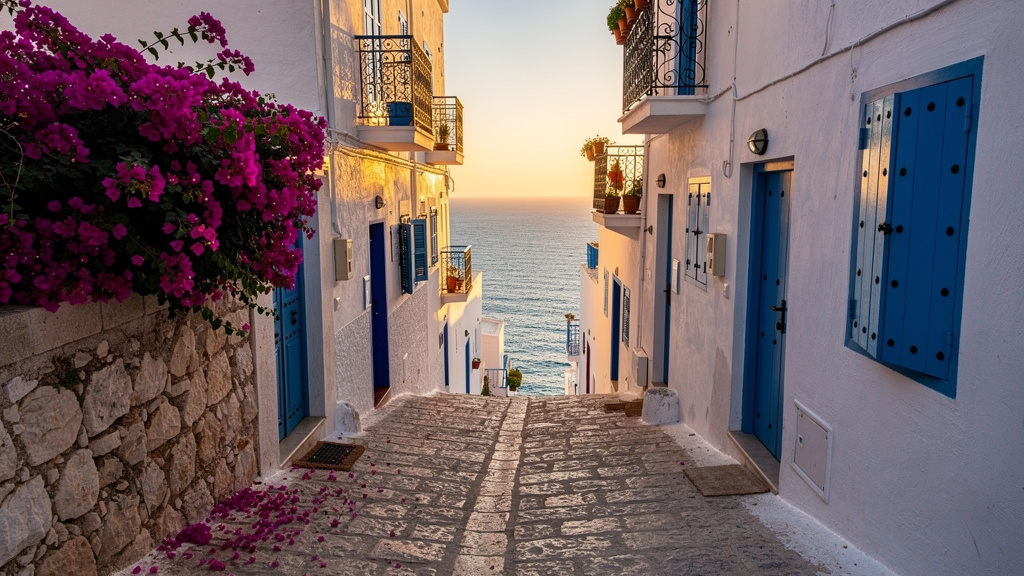
Twenty minutes past Carthage on the same TGM line is Sidi Bou Saïd — the cliffside village that has been a painters’ colony since Paul Klee and August Macke arrived in 1914. The 1915 painting decree restricted all houses to white walls, cobalt-blue window shutters and doors studded with black metal pins. The combination is photographed on roughly a quarter of all Mediterranean travel posters ever printed.
The village walks itself. Climb up Rue Hedi Chaker from the train station, turn left into Rue Habib Thameur, and you arrive at the Café des Nattes — the rooftop café at the top of the village, with reed mats on the floors and the Gulf of Tunis stretching off to the horizon. A long-read on Tunisia’s café culture from Swallow’s Notes covers the pine-nut mint tea ritual, the Sidi Chabaane terrace below the village, and the slow café republicanism that defines a Tunisian afternoon.
The Bardo and the African Colosseum
The Bardo National Museum, in a 19th-century Hussainid palace on the western edge of Tunis, holds the world’s largest collection of Roman mosaics. The Smithsonian’s feature on the collection names the headline pieces — the Virgil mosaic, the 100-square-metre Triumph of Neptune — but a slow half-day in the museum is what the collection rewards. The post-2015 reopening of the building has it in better presentation than it has been in for a generation.
For the Roman finale, El Jem — two hours by train south of Tunis — is the third-largest Roman amphitheatre on the planet, after the Colosseum and the one at Capua. Unlike the Colosseum, it is structurally complete enough that you can climb the upper tiers and walk the underground gladiator galleries. Unlike the Colosseum, the visitor count on a weekday morning runs in the low hundreds rather than the tens of thousands. A combined ticket includes the El Jem mosaic museum across the road, which is the second-best Roman-mosaic collection in the country after the Bardo.
The Tozeur and the Sahara, before the heat
If you have a week and want the southern add-on, the Saharan oasis town of Tozeur is the right base. Swallow’s Notes’ Chott el Jerid guide covers the salt lake causeway, the Mos Espa Star Wars set in the dunes northwest of Tozeur, the Ong Jemel viewpoint, and the Lars Homestead at the edge of the village of Matmata. The driving distances are real — Tunis to Tozeur is 450 kilometres, doable in a day with a stop at Kairouan — but the difference in landscape justifies the effort.
The cut-off for comfortable Sahara travel is the end of June. By mid-July the daytime temperatures at Tozeur regularly cross 45°C and the salt-flat reflectivity makes them feel hotter.
Where to stay
In the Tunis medina, Dar Ben Gacem is the property the city’s serious-cultural-week visitors return to — two restored 16th- and 18th-century dars run as a social enterprise, with profits reinvested in medina heritage projects. Dar el Jeld is the upper-end palace conversion next door — 16 suites in a 17th-century Andalusian-style mansion, a hammam spa, the rooftop bar over the old city, and the sister Dar el Jeld restaurant downstairs.
For beachside Tunis, the Four Seasons Tunis on the Gammarth strip is the city’s leading international five-star — 20 minutes from both Carthage and central Tunis, opened in 2018, the standard upmarket pick for travellers who want the medina by day and a private beach by night.
For the Sahara, the Anantara Sahara Tozeur is the headline property — 93 rooms and pool villas overlooking the Chott el Jerid salt lake, private Star Wars-site excursions, and an architectural conception that owes more to Saharan ksar than to global resort design.
Food and the café republic
Tunisian food is the part most first-time visitors are not prepared for. A 15-dish Tunisian food primer covers the canon — brik à l’œuf (the famously messy filo parcel of egg and tuna), ojja (the spicier Tunisian shakshuka with merguez sausage), lablabi (chickpea breakfast soup), couscous with seven vegetables and lamb, and the harissa that arrives at every table.
For Boukha — the Djerba-origin fig brandy made by the Bokobsa family since 1880 — Carthage Magazine’s deep-read is the cultural primer. It is the ritual aperitif at any serious Tunisian dinner.
And on the hammam ritual — the experience most cultural travellers should book on day two or three — Carthage Magazine’s etiquette guide covers the five-step kessa-glove scrub and the fouta-towel rituals that the city has been quietly perfecting for a thousand years.
Two films of the medina and the Sahara
Two videos that capture the archaeological landscape and the cliffside village:
Carthage Ancient City Travel Guide — Tunisia (4K)
Travel Vlog
Sidi Bou Said — Tunisia: 4K Virtual Walking Tour
Walking Tour
A few things worth knowing about Tunisia
Tunis-Carthage Airport (TUN) has direct flights from Paris, Frankfurt, Rome, London Heathrow and most of the Gulf hubs. The TGM commuter train from Tunis-Marin station runs every 15 minutes to Carthage and Sidi Bou Saïd; the SNCFT national rail goes south as far as El Jem, Sousse and Tozeur. Currency is the Tunisian dinar (non-convertible — withdraw on arrival). Dress is relaxed but more conservative than coastal Europe; the medina is a mosque-and-residential neighbourhood and shoulders and knees covered will spare you uncomfortable looks.
Six weeks until the Sahara summer closes the southern desert routes. The Tunis medina, the Carthage TGM-train circuit, Sidi Bou Saïd’s Café des Nattes, the Bardo Museum’s mosaic halls, El Jem’s third-largest amphitheatre and the Anantara on the Chott el Jerid salt lake — all gathered in our Tunisia collection. Save it before the July heat lands in Tozeur and the Festival of the Medina concert dates are released.
Curated using Epic Itineraries. Log in to save this collection to your own plan.