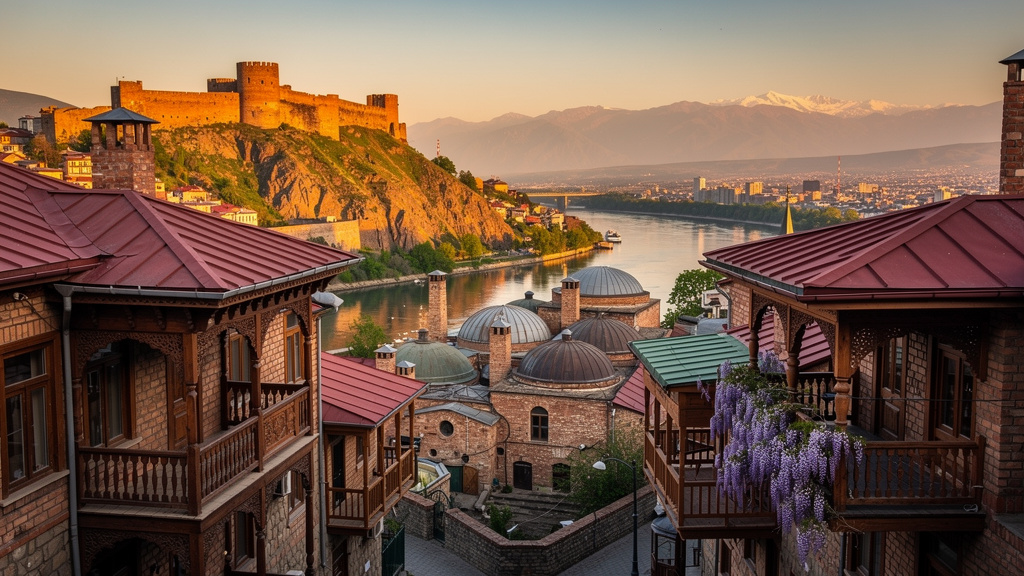
Tbilisi has one of the stranger spring weeks any European capital has ever staged. Over ten days between 1 and 10 May 2026, the city hosts the back-to-back Zero Compromise Natural Wine Festival, the biggest New Wine Festival in the country, and — for the first time ever — a new national public holiday called the Day of Georgian Wine. Georgia has been making wine for 8,000 years, longer than any other culture on earth. In 2026, it finally has a day on the calendar that says so.
It is also, frankly, the best week to visit. Orthodox Easter has passed. The wisteria is heavy over the old town balconies. The Alazani Valley is green and the Kakheti winemakers have their cellar doors propped open. The temperature sits comfortably between 15 and 25°C. And the tourist infrastructure that is arriving fast in Tbilisi — the Design Hotels conversions, the natural wine bars, the Michelin Guide selection — is all close enough to new that you can still feel like an early visitor without being a pioneer.
Why spring is the window
This long-form spring guide from a British writer living in Tbilisi is the single best read for planning a May visit. It lays out 25 specific things to do — the wisteria streets to walk, the Easter rituals that follow Orthodox calendar timing, and the wine festivals that only happen at this time of year. For broader context on Georgia as a country, the same author’s 2026 travel overview is the cleanest primer on routing, money, visas and which regions fit which trip length. A weekend in Tbilisi is perfectly valid; four or five days lets you pair the city with Kakheti. Most travellers come away wishing they had stayed two weeks.
For a walking-paced three-day city itinerary, Salt in Our Hair’s photograph-led guide is the best cross-reference; Page Traveller’s top fifteen and Next Level of Travel’s honest top ten cover the rest — the latter is particularly useful for knowing where the tourist-trap margins are (the Narikala Fortress itself is closed for restoration through 2026, though the Mother of Georgia monument above it is open and the views are the same).
Old Town in an afternoon
Tbilisi’s old town — Kala, running up the hillside from the Mtkvari River — is a labyrinth of 19th-century wooden balconies, brick caravanserais, sulphur-tiled bathhouses and churches that go back to the fourth century. The emblematic set piece is Abanotubani, the sulphur bath district, where domed bath-houses squat under the rocky outcrop of the fortress hill; a private room for two at one of the more atmospheric baths (Chreli Abano is the photographable one with the Persian-tiled façade) costs around €15–30 for an hour. Above the river, the cable car from Rike Park swings you up to the Mother of Georgia monument in four minutes, and the panoramic balcony gives you the city’s geography in a single look.
For context on how these pieces fit together, this local springtime overview is the Georgian-operator view of what is actually happening in April and May, including the Orthodox Easter pilgrimages that give the mountain monasteries an atmosphere they do not have in high summer.
Eating your way through a supra
Georgian food is one of the genuinely underrated cuisines on the planet, and Tbilisi is the best place to understand why. Lonely Planet’s primer on Georgian food is the essential background — the khinkali (Georgia’s soup dumplings), the dozens of regional khachapuri variants (cheese breads, most famously the boat-shaped Adjaruli with a raw egg yolk cracked over the top), the chakapuli lamb-and-tarragon stew that is only served in spring, the fragrant nigvziani badrijani walnut-stuffed aubergine rolls, and the supra — the ritualised Georgian feast, led by a tamada (toastmaster) who delivers elaborate speeches to the table.
For actual addresses, Wander-Lush’s 50 best restaurants in Tbilisi for 2026 is the definitive city food guide — organised by cuisine and neighbourhood, regularly updated, and honest about where locals actually eat versus where tourists are sent. Red Fedora Diary’s locally written 27-strong list adds the dining rooms that Wander-Lush leaves out. And for the single best dumpling crawl in the city, this five-restaurant khinkali tour is the one worth following to the letter — Cafe Daphna’s individually ordered khinkali is a particular win for solo travellers.
The wine calendar, May 2026
If you time one trip to Tbilisi around anything, time it around wine. Red Fedora Diary’s Georgian wine festivals guide is the best single overview of the full calendar, and Eat This Tours’ running events list is the one to keep tab-open for confirmed dates.
The key dates for 2026:
- Zero Compromise Natural Wine Festival, 1–2 May, at Radio City in Tbilisi — a two-day ticketed tasting with the 120+ producers of the Natural Wine Association. 30 GEL (around €10) gets you an all-you-can-drink two-day pass and access to the tamadas, artisans and small-producer importers that are the reason Georgia is the single most interesting wine country for natural-wine drinkers right now.
- National Day of Georgian Wine, 8 May — a brand-new public holiday, first observed in 2026, honouring 8,000 years of qvevri winemaking. Expect free tastings across the old town, producer pop-ups on Agmashenebeli Avenue, and a city that feels like it has collectively taken the afternoon off.
- New Wine Festival, 9 May, at Mtatsminda Park — an outdoor festival at the top of the funicular, free to enter, celebrating the previous autumn’s vintage with live folk music and tastings from every major wine region.
For the operator view on how to fold all of this into a longer trip, Gourmet Wine Travel’s 2026 Georgia tour is a useful reference even if you travel independently — it shows you which cellars and which towns belong on a serious wine week.
The lodging question
Tbilisi’s boutique hotel scene has arrived in the last five years. Design Hotels’ Tbilisi portfolio includes The Blue Fox — a 17th-century merchant’s mansion in the old town with murals by Musya Qeburia and a Michelin-starred restaurant — and Stamba Hotel, a former Soviet printing house converted into one of the most visually striking hotels in the Caucasus. For a wider selection, Wander-Lush’s 12 boutique picks for 2026 goes neighbourhood by neighbourhood — Sololaki for the Art Nouveau streets, Vera for the cafés, old town Kala for the atmosphere. For a single detailed write-up of one of the standout conversions, The House Hotel Old Tbilisi sits on the Mtkvari river at the edge of the Abanotubani bath district.
The Kakheti day trip is the one worth doing
Kakheti, two hours east of Tbilisi, is where most of Georgia’s wine comes from and where qvevri winemaking — the underground egg-shaped clay vessel method — is still living heritage rather than museum piece. Wander-Lush’s Kakheti itinerary is the reference for planning — it covers Sighnaghi (the walled “city of love” on the ridge above the Alazani Valley), Telavi, Alaverdi Monastery’s working 11th-century cellar, and the small-producer visits that make the day. A compact day-trip account is the best honest read on what fits into one day and what does not — the short answer is that Sighnaghi plus one cellar is the realistic limit, and two nights in Kakheti is better than one day.
Two films of the city
Two videos to get the feel of the city and the valley below it:
Tbilisi, Georgia — The Ultimate Travel Guide
Hey Nadine
Georgia Travel Vlog — The Cheapest European Vacation?
Lost LeBlanc
One week, eight thousand years
Georgia is the country that was quietly making wine while everyone else was inventing agriculture. For one week in May 2026 — starting with Zero Compromise on the 1st and closing with the New Wine Festival on the 9th — it is also the best argument in Europe for booking a shoulder-season flight into somewhere you have never been.
Eleven days until Zero Compromise opens. Wine-festival dates, khinkali crawls, design hotels and Kakheti cellar visits — all in our Tbilisi collection. Save it, book your flights, and leave the old town a glass heavier than you arrived.
Curated using Epic Itineraries. Log in to save this collection to your own plan.