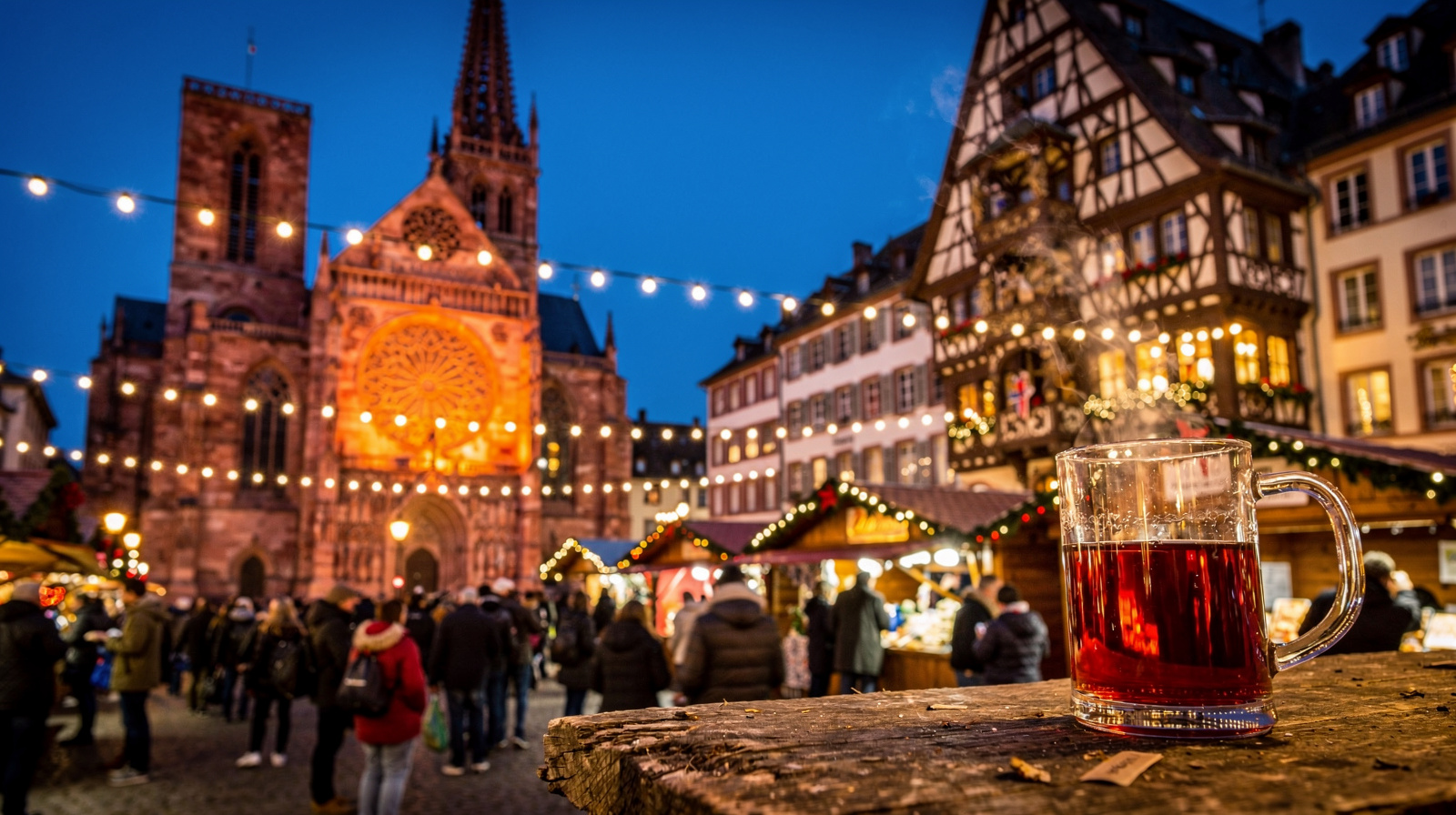
The Christkindelsmärik has been held in Strasbourg since 1570, more than a century before the city became French. It moved about over the centuries and landed on Place Broglie, where it still is. Around it the city has built something far bigger: more than 300 chalets across eight markets on the Grande Île, a 30-metre fir on Place Kléber, strings of lights over almost every street in the old town, and 3.4 million visitors last year. The city calls itself the Capitale de Noël, and for four weeks a year it’s hard to argue.
Strasbourg is also having a moment of its own. Expedia’s UK search data for this autumn put it third among international destinations on the rise, up 170 per cent. The 2026 dates haven’t been announced yet (the official Capitale de Noël site was still showing last year’s edition at the end of September), so don’t trust the blogs that print a definite opening day. Last year the market opened on a Wednesday, 26 November, which ended the supposed rule that it always starts on a Friday. What’s safe to plan around is late November to 24 December, and the rooms for those Advent weekends are the thing to sort out now.
Eight markets, one island
The Grande Île is the old town, ringed by the Ill and on UNESCO’s list, and the markets are spread across it. Place Broglie holds the original Christkindelsmärik and a 17-metre Christmas pyramid. The chalets round the cathedral and Place du Château sell the ornaments and crafts. Under the big tree on Place Kléber, a hundred-odd charities take turns at the solidarity market. The Quai des Délices on Terrasse Rohan is given over entirely to food. Farmers from across Alsace sell at the Irréductibles Petits Producteurs in Square Louise Weiss, and the Marché OFF on Place Grimmeissen is the alternative one: sustainable, local, a bit more interesting. France 3’s practical guide has the addresses, the 11:30–21:00 hours and the car-park rules from 2025, which is the best guide to 2026 until the city publishes its decree.
The island is closed to traffic while the market runs, and there are bag checks on the way in. That perimeter has been there since the attack on the market in 2018, and in practice it only means a short queue. The trams still run, but the stops inside the zone close during market hours. For the order in which to walk it, Strasbourg365’s 2026 guide and My Weekend in Alsace’s local’s-eye view both give the same advice: come on a weekday from Tuesday to Thursday, do the chalets from late morning, and save the illuminations for after dark. Saturdays in December are the busiest days of the year. Beyond the Guidebooks has a clear map if you want to plan a route.
What to eat on the way round: vin chaud, which comes white as well as red here, bredele, the small Alsatian Christmas biscuits every family bakes by the tinful, pain d’épices, bretzels, and hot flammekueche straight from the oven. Around 6 December, the feast of St Nicholas, you’ll see manala too, little brioche men.
The cathedral, from the inside and from the top
Every lit-up street in the old town seems to end at the cathedral. It’s built of pink Vosges sandstone and has a single 142-metre spire, and it’s free to go in. During the market you can walk in all day on weekdays through the south portal (visiting hours here). The astronomical clock puts on its show at 12:30: the apostles file past, and there’s a short film beforehand. Tickets cost a few euros, are sold the same morning and can’t be booked, so in Advent get there by half past eleven.
The platform climb is about 330 steps up to 66 metres, and costs €10. You queue at Place du Château, and the last climb goes up at 17:15 in winter. From the top, on a clear day, you can see across the island and the Rhine to the Black Forest. For the classic view back towards the spire, walk to the Barrage Vauban, a seventeenth-century fortified weir with a free roof terrace. It looks out over the covered-bridge towers and the half-timbered houses of Petite France, which has its own small market on Place Benjamin Zix. The terrace closes at four in winter, so go before dusk.
One place to leave off your list: the Musée Alsacien is closed for renovation until June 2028. Plenty of guides still send people there.
Winstubs, and two stars’ worth of ambition
The winstub is where Strasbourg eats in winter: a panelled wine room with low beams, carafes of Riesling and dishes built for cold weather, such as choucroute, baeckeoffe, fleischschnacka and a slab of munster. Do Eat Better’s winstub primer covers the classics, and two of them are worth booking ahead. Chez Yvonne, on rue du Sanglier, holds a Michelin Bib Gourmand and is as popular with the city’s regulars as with visitors. Le Clou, a short walk from the cathedral, is the one to choose if you want the full experience, with nobody in a hurry.
For a proper dinner, Au Crocodile has been serving since 1840, once held three Michelin stars under Émile Jung, and now holds one under Romain Brillat. It’s the grown-up way to spend a December evening in the city. Across from the Palais Rohan, 1741 holds a star as well. Book both well ahead for December.
Where to wake up
The whole point of Strasbourg in Advent is being able to walk out of the door into the lights, so stay on the island, inside the car-free zone. Cour du Corbeau is an MGallery hotel in a centuries-old inn a few minutes from the food market on the quay, and it’s the most atmospheric address in the city. The Régent Petite France sits on the water in the old millers’ quarter and has a spa for the end of a cold day. Hôtel Gutenberg is the sensible choice: four-star, central, and close to Place Kléber. Weekday nights are cheaper and easier to find. For a Saturday in December, book in October.
Colmar, thirty minutes south
The TER to Colmar takes about half an hour and runs up to three times an hour. You don’t need a reservation, and it can’t sell out. Colmar’s six Christmas markets are officially listed as running from 23 November to 29 December, spread from Little Venice to the old customs house. What’s harder to arrange is the villages. Riquewihr, Kaysersberg and Ribeauvillé are all on the Wine Route and all have markets, but Kaysersberg’s is held only from Friday to Sunday. The official Christmas shuttles run from Colmar station from 27 November to 20 December, with a €17 day pass. Tickets go on sale at noon on Thursday 12 November, and the weekend seats go first.
Two short films before you go — one that asks whether Strasbourg deserves its title, and one that eats its way round the market:
Does Strasbourg Really Deserve the Title 'Capital of Christmas'?
DW Travel
The STRASBOURG Christmas Market Everyone Talks About
Les Frenchies
From Amsterdam, by rail
The Man in Seat 61 sets out the three rail routes. Via Brussels, the Eurostar connects to one of two daily direct TGVs, about five and a half hours door to door. Via Paris, you change stations from Nord to Est on foot, and it takes six to seven hours. Via Frankfurt, it’s a direct ICE and then a TGV. If you do fly, Strasbourg-Entzheim is nine minutes from the main station by shuttle train. Don’t bring a car; you can’t drive onto the island anyway.
About eight weeks until the chalets open. The market map, the cathedral climb, the Bib Gourmand winstub, the Crocodile, three island hotels and the Colmar shuttle-ticket date are all in our Strasbourg collection. Save it, book a weekday night on the Grande Île, and take your second vin chaud white.
This guide was curated using Epic Itineraries — save links from anywhere on the web, organise them into collections, and turn research into itineraries.