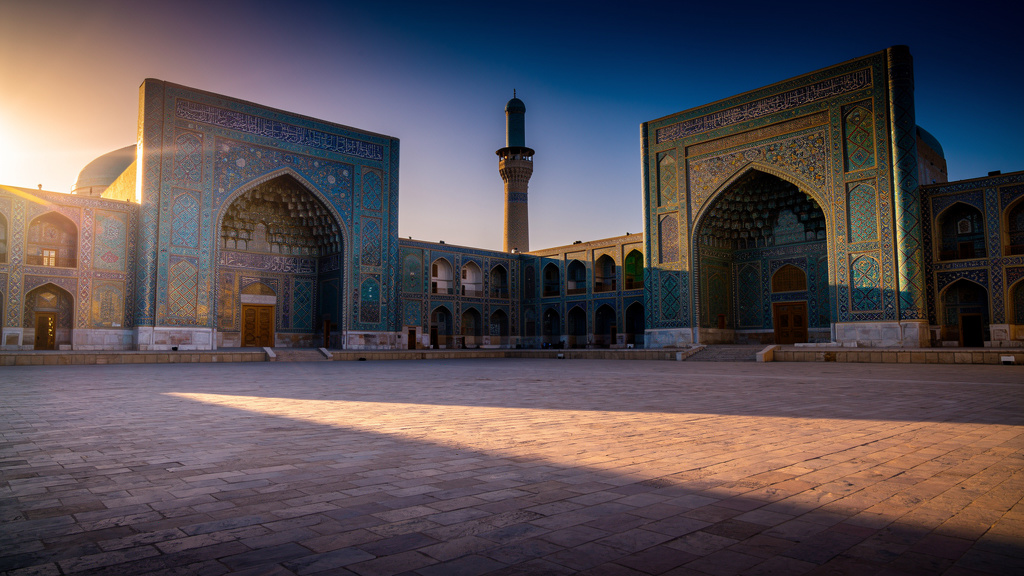
The Registan does not look real at first. Three madrasas — Ulugh Beg, Sher-Dor, Tilya-Kori — face each other across a paved square the size of a small football pitch, every surface from their portals to their dome interiors glazed in a deep cobalt and turquoise that seems to belong to a different chemistry of colour. The closest analogue is probably Esfahan. The closest cultural cousin is probably Bukhara, two hundred kilometres west on the same train line. Nothing else looks like this.
For a long time it was hard to get to. Visa rules made Uzbekistan an inconvenient stop on a longer Central Asian loop. Both of those things have flipped. The eVisa is now thirty days online, the Afrosiyob fast train runs Tashkent–Samarkand–Bukhara at over 200 km/h, and direct flights from Frankfurt, Istanbul, Riga and now London Heathrow have shortened the journey to a single connection. The country is having a quiet boom, and Lonely Planet has been pushing the Silk Road triangle on its 2026 must-do experiences list.
May is the month to go.
Why May closes the window
By June, daytime temperatures in Bukhara and Samarkand are pushing 35°C and the Registan tiles bake the courtyard into a furnace by noon. May sits in the narrow corridor where the days are warm (mid-20s°C), the evenings still cool, and the morning light angles low enough that the cobalt mosaic glazes pop the way they were designed to.
Caravanistan’s master Silk Road planner — the most trusted independent regional guide, written by Steven Hermans over more than a decade — is the strategic resource for the whole route. It is opinionated about pacing, brutal about the parts of the trip that disappoint, and unsentimental about the parts that work. Read it first.
For the more conventional one-week version, Lonely Planet’s curated seven-day plan hits Tashkent, Samarkand, Bukhara and Khiva at a sustainable pace. Wander-Lush’s two-week version extends the trip to include the Aral Sea — which is not a beach destination, exactly, but is one of the most striking environmental sites on the planet. Pick the depth of trip that matches your stamina.
Samarkand on a two-day clock
Most travellers give Samarkand two nights. Wander-Lush’s 2-3 day plan is the cleanest single route through the city: Registan at dawn, Bibi-Khanym mosque before midday, the bazaars in the afternoon, Shah-i-Zinda at the start of the second day before the buses arrive. Then Gur-e-Amir — Tamerlane’s tomb, a tighter, more intimate counterpoint to the public theatre of the Registan.
Shah-i-Zinda is the part that catches first-timers off-guard. It is not a single building. It is a narrow alley of tile-clad mausoleums climbing a hillside, eight centuries of accreted decoration, and Bayt al-Fann’s deep-history piece on it is the best primer on what you are looking at. Three distinct types of tilework — banna’i brick, glazed cuerda seca, mosaic faience — across roughly forty surviving structures.
Mark Wiens’ Samarkand guide is the food-anchored counterpart, and it is the one to bookmark for lunch. He sits in for plov at Osh Markazi — a working canteen where the rice is cooked outdoors in cauldrons large enough to feed a wedding — and shoots the giant kebab grill at the back of the central market. Both are still operating. Both are about the same price they were when he filmed.
The train across to Bukhara
The Afrosiyob — Uzbekistan’s high-speed Talgo — is the easiest two-and-a-bit-hour journey from Samarkand to Bukhara, and Seat 61’s Uzbekistan rail reference is the definitive English-language source for booking, classes, fares and the booking-window quirks. VIP class is around $30 in May. Business class is the right balance for most travellers. The dining car serves passable plov and consistently bad coffee; pack a thermos.
Bukhara is the older of the two cities and, for many travellers, the more lovable. The Old Town is contiguous, walkable, and remarkably lived-in: the bakers still fire non bread out of clay tandoors at 5am, the carpet sellers still nap on their merchandise, and Lyabi-Hauz — the cluster of madrasas around a 17th-century reflecting pool — fills with families on warm evenings.
The Silk and Spices Festival
The reason May 2026 specifically is worth booking is the festival. The 18th edition of the Silk and Spices Traditional Festival runs in Bukhara’s old town for three days at the end of the month — Advantour’s official festival reference confirms the late-May timing and the core programme: silk-weaving demonstrations, the spice market under the historic trading domes, dance and shashmaqom music ensembles, master craft workshops, and parades that take in Lyabi-Hauz, the Po-i-Kalyan ensemble and the Ark fortress.
It is one of the better-organised cultural festivals in Central Asia and is still notably under-touristed. Bukhara hotel rates climb roughly 30% during the festival window, which sounds aggressive until you compare it with European festival pricing.
Where to sleep — heritage stays still possible
Bukhara is the city for restored caravanserai and merchant-house conversions. Caravanistan’s neighbourhood-by-neighbourhood Bukhara accommodation guide is the honest comparison piece: it ranks heritage stays against new builds, names the ones that actually preserve their original carved-wood ceilings and frescoes, and flags the ones that have been gutted and re-clad to look the part.
Two we would book on its recommendation: Caravansaray Rashid — a 19th-century trading inn near the Sarrafon dome, restored with most of its courtyard rooms intact — and Lyabi House, a merchant mansion next to the Lyabi-Hauz pool with the well-regarded Ayvan restaurant on its courtyard. Both are walking distance to most of the old town.
Food: plov, samsa, and the wider table
Lonely Planet’s Uzbekistan food primer sets out the regional plov variations — Samarkand’s chunky-rice version, Bukhara’s drier and slightly sweeter cousin, Fergana’s everything-on-top — alongside the supporting cast of samsa from tandoor ovens, non bread stamped with the city’s specific seal, and shashlik over coals at every street corner.
Eva Darling’s Samarkand restaurant round-up is the ground-truth list for where to actually sit down: a mix of plov shops, slow-food restaurants, and the small modern wave of restaurants opening near the Old City. RestaurantGuru’s plov ranking across the three cities is the cross-reference for the headline dish.
The crafts day trip
If you have a day to add, Margilan is the silk-weaving town in the Fergana Valley, and Atlas Obscura’s piece on the Yodgorlik Silk Factory is the best primer. You walk the entire production line — cocoon to ikat — by hand, with the dye masters happy to talk through the indigo and madder-root vats. The recent Euronews piece on Rishtan ceramics covers the parallel pottery town with its ishkor-glaze tradition. Both are worth the detour for anyone interested in coming home with something that was not bought in an airport.
Watch first
Two videos that give you the sense of Samarkand’s food and Bukhara’s pace before you arrive:
Amazing Uzbek Food in Samarkand — Giant Kebab Grill + Ancient Uzbekistan
Mark Wiens
This Is Samarkand! Must-Visits of the Ultimate Silk Road City
Kara and Nate
The eVisa, the Tashkent overnight, and the Afrosiyob the next morning
The eVisa takes 48 hours and costs around $20. Direct flights from European hubs land in Tashkent; the easier onward leg is the Afrosiyob from Tashkent to Samarkand the next morning. Most travellers spend a single night in Tashkent and head out at dawn — that is the pattern Caravanistan recommends, and it is the right one.
Four weeks until the Silk and Spices Festival opens in Bukhara. The 2-3 day Samarkand routing, the Afrosiyob fare quirks, restored caravanserai stays around Lyabi-Hauz, plov shops worth queuing for and Margilan ikat-weaving day-trip notes — all in our Samarkand collection. Save it before May rates climb 30% for the festival weekend and the heritage rooms book out.
Curated using Epic Itineraries. Log in to save this collection to your own plan.