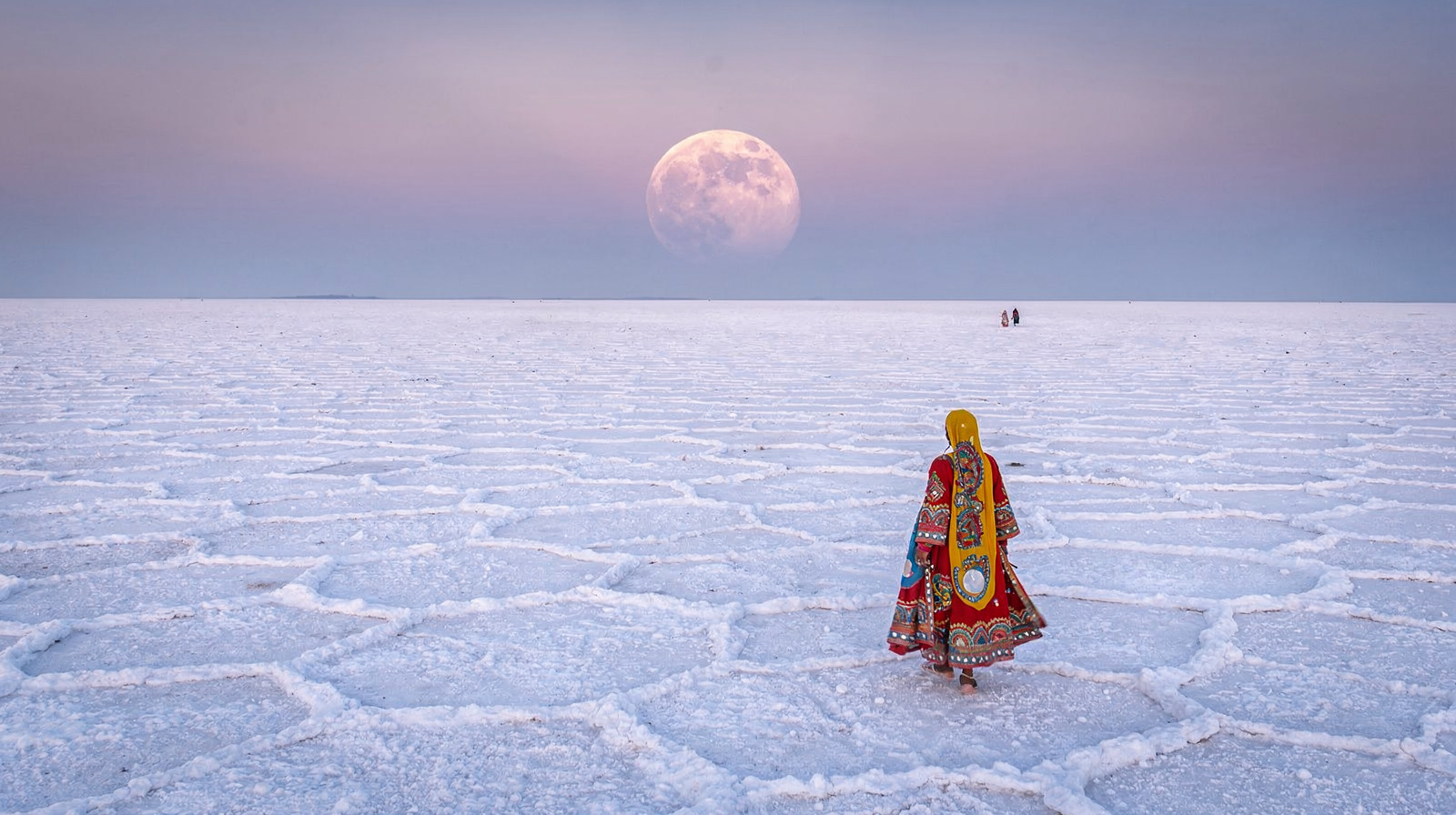
At 20:23 on Tuesday 24 November, the moon will be full over the far west of India. Most places it’s just a bright night. On the White Rann of Kutch, a salt flat that runs out towards the Pakistan border, it changes the ground. The crust dries into low ridges that lock together like tiles, and a full moon turns the whole plain silver from your feet to a horizon so flat it looks drawn with a ruler. People drive for hours to stand on it after dark, and they’re right to.
The season for it starts on 1 November, when the Rann Utsav Tent City reopens at Dhordo, the last village before the salt. Evoke Experiences runs it with Gujarat Tourism, and it stays up until 7 March 2027 (Travel Trade Journal has the season announcement). In September, Lonely Planet put Gujarat in its Best in Travel 2027 list, labelled “best for salt flats and wild lions”. Its longer guide to the state gives the wider picture, but the salt is the reason Kutch is on the list.
Time it by the moon, not by Diwali
Most calendars mark Diwali week, 8 to 14 November, as peak season, and it is: Gujarati school holidays, full camps, busy roads. But Diwali falls on the new moon. That’s a fine week for stars and a bad one for silver salt. The nights you want are the 22nd to the 25th of November. In December the moon is full at 06:58 on the 24th, so the brightest evenings are the 23rd and 24th rather than the dates some agents print. GoAsia lists the full-moon windows through to February.
Then there’s the water. The Rann floods every monsoon and has to dry out before it turns white. After last year’s heavy rains it was still underwater in late November, and visitors who came for white salt found standing water. This year looks very different: by 20 September Kutch had had only 57 per cent of its normal rainfall, and the monsoon had left Gujarat by 3 October. A dry monsoon usually means a firm, white crust early in the season. Usually isn’t a promise, though, so check recent reports before you set off.
The permit, and the website to avoid
The White Rann is a border area, so every visitor needs a day permit. You get it at the Bhirandiyara checkpoint on the road from Bhuj, or in advance from the state’s official portal, rannpermit.gujarat.gov.in. Last season it cost ₹100 per adult. Foreign visitors need their passport and a copy of their Indian visa. One warning: the old address, rannpermit.com, now redirects to a gambling site, and older blogs still link to it.
Bhirandiyara has something else worth stopping for: mawa, a sweet made by slowly reducing milk with sugar. Around fifteen dhabas along the highway sell it by the cup, and nobody drives past without buying some.
Bhuj, rebuilt
The 2001 earthquake struck on Republic Day morning, 26 January, and destroyed much of Bhuj’s old town. The best place to understand what happened is Smritivan, a 470-acre memorial on Bhujiyo Dungar, the hill above the city. It has fifty check-dams carrying the names of the dead, a young forest planted on the slopes, and one of the best-designed museums in India. The museum is closed on Mondays. The memorial grounds open at dawn.
Down in town, Aina Mahal is an eighteenth-century palace of mirrored rooms and Delft-style tiles. Next door is Prag Mahal, a nineteenth-century palace built in Italian Gothic, clock tower and all. Outlook Traveller’s guide to the walled city covers the opening hours, which vary. Bhuj is also where you eat. Dabeli, a spiced potato bun with pomegranate and roasted peanuts, was invented in Kutch, and Mohan Dabeli is the place to try one. The thali at Hotel Prince has been a reliable lunch since 1974. This round-up of Kutchi dishes points you to odho, a smoky aubergine dish, and gulab pak in Khavda.
Villages that make things
Kutch is one of the great craft regions of the world, and you can see the work being made. Start at the Living and Learning Design Centre in Ajrakhpur, the museum run by Shrujan, which Lonely Planet’s coverage singles out. Its embroidery galleries explain which community stitches what. Ajrakhpur itself is where Khatri families block-print ajrakh cloth in natural indigo and madder. Bhujodi, 8 km from Bhuj, weaves. In Nirona, one family keeps rogan painting going: castor-oil paint drawn out into fine threads. Maverickbird’s handicrafts route links the villages in a sensible order. If you’d rather have someone open doors for you, Kutch Adventures India runs craft and community tours from Bhuj.
Beyond the salt
Kalo Dungar, the highest point in Kutch at 462 metres, looks out across the Rann towards the border. After the evening prayers at its temple, priests feed the jackals that come up from the scrub. There’s an army post on the summit, and you can’t photograph it. To the east, the “Road to Heaven” is a causeway about 30 km long, laid across the salt to Khadir Bet. At the end is Dholavira, a Harappan city some five thousand years old, with at least sixteen reservoirs cut into the rock. Inditales explains the water engineering better than any signboard on site. This season Evoke is adding 35 tents beside its Dholavira property, so an overnight there is now practical.
The Little Rann, four or five hours’ drive south-east, is a separate trip with its own reason to go. It is the last refuge of the Indian wild ass, the khur, and the 2024 census counted 7,672, up by a quarter in four years. Rann Riders at Dasada is the established base for safaris.
The salt edge or Bhuj
Spend two nights on the edge of the Rann and two in or near Bhuj; one base can’t do both. For the festival itself, with cultural evenings, buffet dinners and a buggy out to the salt, choose between the Tent City and the Praveg White Rann Resort. Both are official Rann Utsav camps at Dhordo. Shaam-e-Sarhad in Hodka is quieter and cheaper. The village tourism committee owns and runs it, it has just twelve mud tents and bhungas (the round, thatched Banni huts), and there’s no air-conditioning and no TV, which out here is a selling point. In Dhordo itself, Gateway to Rann is run by the village panchayat and is close enough to walk to the salt. For the Bhuj half, Devpur Homestay is a family-run manor from 1905 with six suites, well placed for Nirona and the western villages.
Press play
Two travellers on the salt: one under the full moon with detours to Kalo Dungar and Dholavira, one on the Road to Heaven:
EP 1 Rann of Kutch, Salt Desert, Full moon night rann, Kalo Dungar, Dholavira Harappan site, Gujarat
visa2explore
White Desert of India | Rann of Kutch | Road to Heaven | Dholavira Village | Gujarat
Kanishk Gupta
The logistics
Bhuj airport is 5 km from town, with non-stop Air India flights from Mumbai. By rail, the overnight Kutch Express links Bhuj with Ahmedabad and Mumbai Bandra Terminus, about 15 hours end to end. The Namo Bharat Rapid Rail does Ahmedabad to Bhuj in under six hours. From Bhuj to Dhordo is 80-odd kilometres, roughly two hours with the permit stop. Hire a car and driver for the whole stay: there’s no public transport to the Rann worth relying on.
Seven weeks until the full moon rises over the salt. The two festival camps and the village stays, the permit routine, Bhuj’s dabeli and thali, the Shrujan craft museum and the road to Dholavira are all in our Rann of Kutch collection. Save it, plan around the 24th, and walk out onto the white after dinner.
This guide was curated using Epic Itineraries — save links from anywhere on the web, organise them into collections, and turn research into itineraries.