Within nine days this April, Rabat opened the tallest building in Morocco and a theatre designed by Zaha Hadid. That same month it began its year as UNESCO’s World Book Capital. Six months earlier, National Geographic had called 2026 “Rabat’s breakout year”, and in September Lonely Planet put the city in Best in Travel 2027 under the line “best for riad life and sunset surf”. After all that attention, you might expect hustlers on every corner. Walk down the Rue des Consuls and nobody will try to drag you into a shop.
That is Rabat’s real appeal. It is the capital, run by ministries and full of embassies, and not dependent on tourists, so the city goes about its business and lets you look around. National Geographic’s case for the city describes it as “far from the hustle and bustle of Marrakech and Casablanca”, and after a day in its medina you’ll see what they mean. The World Book Capital programme runs into April 2027, with 342 events spread across the year (Time Out has the background). Its biggest event, the May book fair, has already happened, so treat the title as a sign of what the city is like rather than a reason to time your trip.
The kasbah at the river mouth
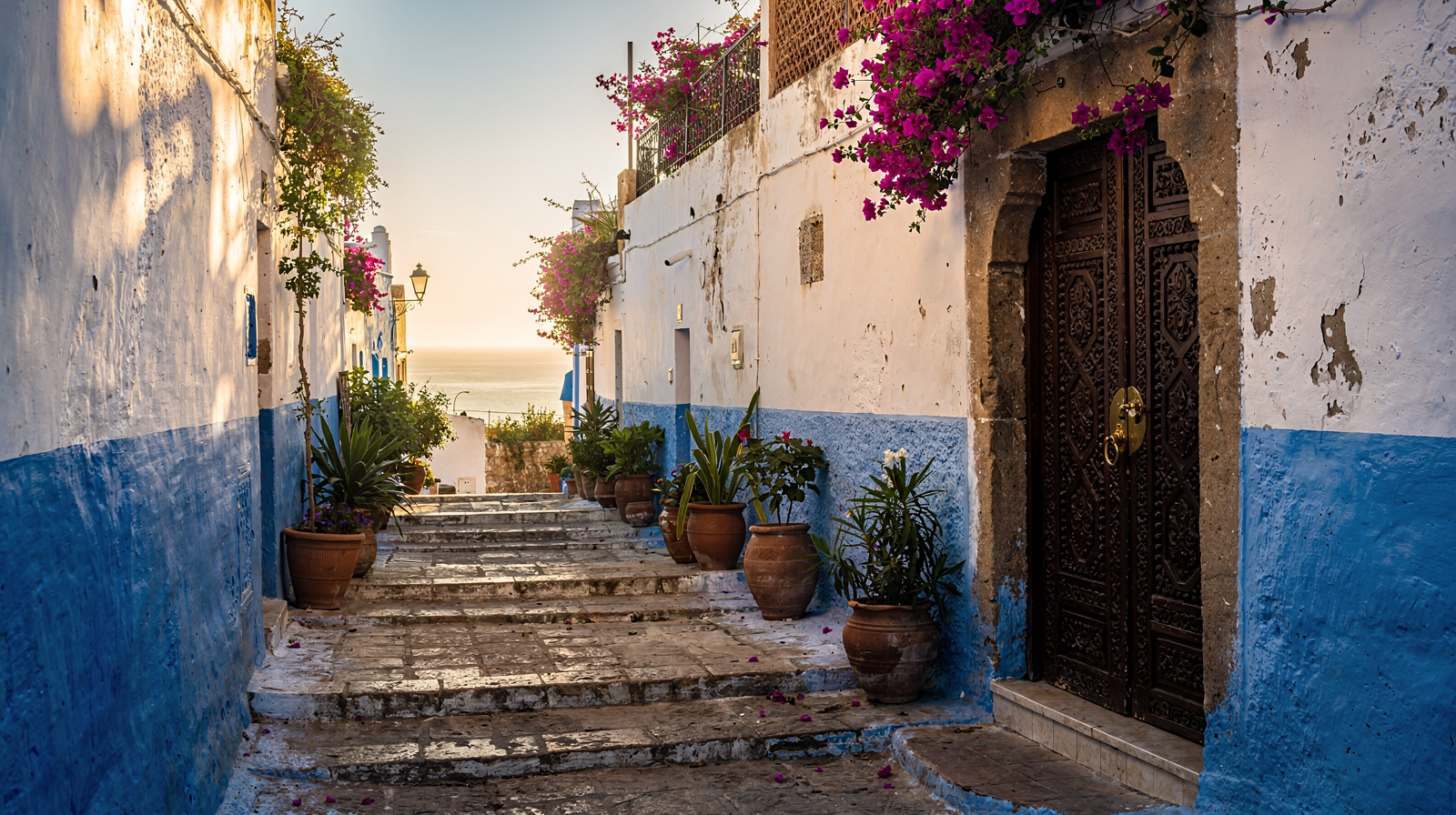
The Kasbah des Oudayas sits on a bluff where the Bouregreg meets the Atlantic. Inside the walls, the lanes are whitewashed on top and painted blue below, and entry is free. At the bottom are the Andalusian Gardens and the Café des Oudayas, the old Café Maure. It was rebuilt in 2021, and it’s still the place to drink mint tea and eat almond pastries while you watch rowing boats cross to Salé. Go late in the afternoon, when the light turns gold.
Directly below the kasbah, the river mouth is where Rabat surfs. Lonely Planet’s writer Sally Kirby picked the city for the sunset surf at Oudaya, and the beach club at its foot rents boards and wetsuits by the session. Back on the river, Le Dhow is a replica wooden trading ship moored under the walls, with three decks. Go for a drink on the top deck at sunset rather than for the food.
A medina that leaves you alone
Rabat’s medina is small, flat and easy to find your way around. Start on the Rue des Consuls, named after the foreign consuls who once had to live there. It’s lined with carpets, brassware and stalls of second-hand books, which suits the World Book Capital year. Lonely Planet’s first-time guide gives sensible prices: maakouda, a potato fritter in bread, for five to fifteen dirhams on the street, and a chicken tagine from around a hundred. For a proper Moroccan dinner in the old town, Dar Zaki on Rue Moulay Brahim is one of National Geographic’s picks. Remember that on Fridays a lot of the city shuts around midday for prayers, and the custom is a long couscous lunch.
A minaret nobody finished, and a ruin full of storks
In 1195 the Almohad sultan Yaqub al-Mansur started building what was meant to be one of the largest mosques in the world. He died in 1199 and work stopped. What’s left is the Hassan Tower, a 44-metre minaret, standing over a field of 348 column stumps. Across the esplanade is the Mausoleum of Mohammed V. You look down on the tombs from a balcony, guards stand at the doors in full ceremonial dress, and you should dress modestly to go in.
About half an hour.s walk south, Chellah is a walled garden of Roman and Merinid ruins, and storks nest on every broken minaret. From October it’s open from 9am to 6pm. It reopened after major renovation in 2024, with audio guides in four languages, and it deserves two hours. Ciconia, the restaurant inside, looks out over the city. For modern art, the Mohammed VI Museum is a few blocks from the station.
The new skyline
The Théâtre Royal de Rabat, as Hadid’s building is now called, opened on 22 April. It has a 1,821-seat main hall and a 7,000-seat amphitheatre on the riverbank, and it looks like a wave that has set solid. Morocco World News covered the gala opening. There are no public tours, so the way inside is a ticket. This autumn’s programme includes Kadim Al Sahir on 9 October, the comedian Mo Amer on 31 October and the composer Guy Manoukian on 5 November. There’s a dress code: no jeans, shorts or flip-flops.
Across the river on the Salé bank, the Mohammed VI Tower rises 250 metres over 55 floors. It houses the 55-room Waldorf Astoria, which took its first guests in May. There is a heritage observatory at the top, but it isn’t clear yet whether the public can visit. Salé itself is a quieter, older twin. Cross by tram or by rowing boat, then find the Merinid madrasa, whose carved cedar and stucco are some of the finest in Morocco. Malika in Morocco’s guide to Salé covers the rest of the old town.
Riad or river
To get the most from Rabat, stay inside the medina walls. Dar El Kebira is a ten-room riad a few steps from the Rue des Consuls, with roof terraces looking towards the kasbah and its own hammam. Euphoriad was once the Pasha of Rabat’s residence. It now has eight rooms, a plunge pool and a terrace over the river and the sea. If you want something cheaper, Le Pietri Urban Hotel is a small, well-run city-centre hotel within walking distance of the medina, the station and the tram. For a big occasion, the Waldorf Astoria puts you inside the new skyline, looking back at the old city.
On screen, before you arrive
A first-timer’s surprise, and a look at the new city on the riverbank:
I DIDN'T EXPECT RABAT TO BE LIKE THIS!
Ride with Gabi
The NEW Face Of Rabat: Morocco in 2026 (Most Advanced City)
KNT
Getting there and back
Transavia has flown Amsterdam to Rabat since November 2025, and in April Ryanair opened a base at Rabat-Salé. From the airport, a taxi takes about twenty minutes and costs from 280 dirhams, and the airport bus is 28. The Al Boraq high-speed train reaches Tangier in about an hour and twenty minutes. Casablanca is about an hour away by train, close enough for a morning at the Hassan II Mosque, whose guided tours are open to non-Muslims.
October is the month: highs of 24°C, a sea at 21°C, and November’s rains still a few weeks away. Riads off the Rue des Consuls, the Royal Theatre’s autumn programme, Chellah’s storks, a boat across to Salé and the sunset break below the kasbah are all in our Rabat collection. Save it, book the flight, and end your first evening with mint tea above the river mouth.
This guide was curated using Epic Itineraries — save links from anywhere on the web, organise them into collections, and turn research into itineraries.