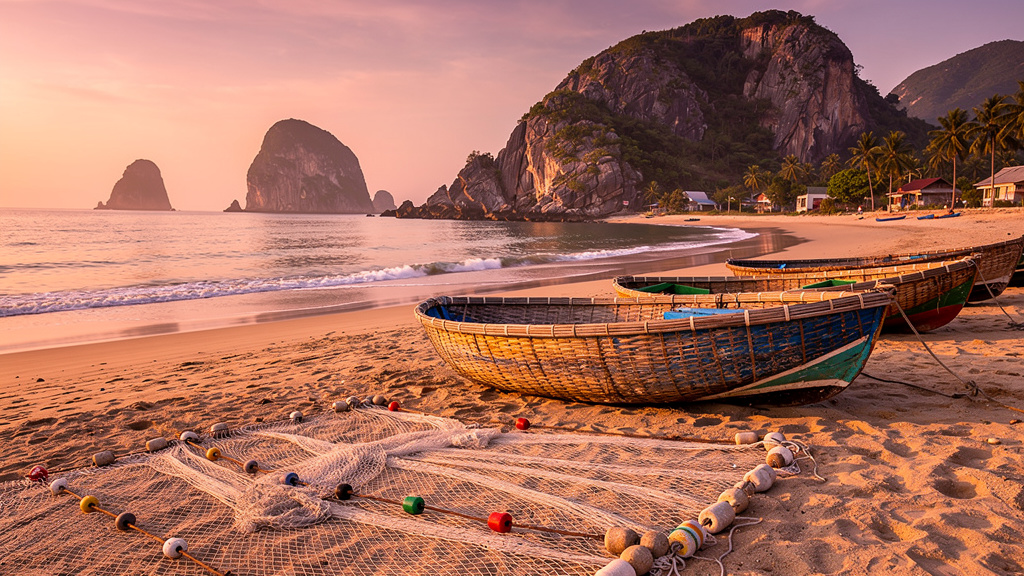
The standard Vietnam route runs Hanoi to Hội An to Sài Gòn, sometimes with Đà Nẵng tagged on for the China Beach hotels. Halfway between Đà Nẵng and Nha Trang, the train and the highway both pass through a small coastal city that almost nobody gets off at. Quy Nhơn is the capital of Bình Định province, has a population the size of Brighton, and contains the best stretch of beach the south-central coast still keeps mostly to itself. Lonely Planet has just put it on the Best in Travel 2026 list — “best for coastal adventures and seafood delights” — which is the kind of nudge that closes a window quickly.
It has not closed yet. May is the moment.
The window is the dry season’s tail
Bình Định’s weather follows the pattern of Vietnam’s south-central coast: roughly January to early May is dry, June through August is the hot domestic-tourism peak, and September through December is the typhoon season. May is the last month where the sea is calm, the humidity is bearable, and the resorts are not yet block-booked by Hanoi and Saigon families on school holidays. The whole region is in roughly the same window as Hội An — except Hội An gets a queue and Quy Nhơn does not.
The single most useful resource for understanding the geography is Vietnam Coracle’s deep guide to the Quy Nhơn–Phú Yên coastline — Mark Owen has been writing the most respected expat travel site in Vietnam for over a decade, and his beaches piece is the one to read before you finalise any plans. He maps the entire coast cove by cove, names the best fishing-village restaurants on each, and is honest about which beaches are now built-up enough to skip.
Bãi Xếp and the city stretch
Most travellers who get off the train head for one of two beaches. The first is Bãi Xếp, a small fishing-village cove fifteen kilometres south of the centre, with a handful of guesthouses on the sand and a working fleet of round basket boats that come in at dawn. Indie Traveller’s Quy Nhơn guide frames it well — the village retains the mix of beach bums, long-stay backpackers and a quiet fly-and-flop set that arrived for three days and stayed three weeks. Haven Boutique Hotel and Big Tree Bistro is the spiritual centre — a guesthouse on the beach with a wood-fired pizza oven that you can hear from the sand at sunset. It is the place most repeat visitors book first.
The second is the city beach itself — a four-kilometre arc curling past the old French quarter, with seafood stalls and grill carts that come out at dusk along the corniche. The Vietnamcoracle food guide has hand-drawn maps of the Trần Đức seafood strip — a single street where every restaurant is local-owned, the menus are minimal, and the catch arrives directly from the boats moored fifty metres away. The pattern is that simple.
The Cham brick towers nobody told you about
Quy Nhơn was the capital of the Cham kingdom of Vijaya from the eleventh to the fifteenth century — a polity of Hindu-Buddhist origin that occupied much of central Vietnam before the Vietnamese push south. Vietcetera’s Cham towers explainer is the best English-language source on the heritage — fourteen surviving brick-tower complexes still scattered across Bình Định, including the Bánh Ít / Silver Towers complex on a hilltop forty minutes north of the city, and the Tháp Đôi Twin Towers right inside Quy Nhơn itself. The brickwork at Bánh Ít is the more impressive — Khmer-influenced, almost no mortar, and the towers stand in their original courtyard arrangement.
Saigoneer’s bird’s-eye-view feature is the photographic counterpart and shows the sites from above, with the relationship between the towers and the surrounding rice paddies. Both are best in the late afternoon — golden hour against terracotta brick, no crowds.
The food that earns the trip
Bình Định cuisine is its own thing. The headline dish is bánh xèo tôm nhảy — “jumping shrimp pancake”, a smaller, crisper rice-flour pancake than the Saigon version, made with tiny live shrimp that go in the pan moments before serving — and you eat it wrapped in herbs and rice paper. Vietcetera’s Quy Nhơn food specialty guide names the addresses; the most-cited bánh xèo place is Bà Năm at 49 Diên Hồng, a one-storey local kitchen that opens late afternoon and runs until the prawns sell out.
For seafood by the water, Quán Ăn Bồng Bềnh — a floating restaurant in a fishing village south of the city, operating since 1992 — is the more atmospheric option. The catch is whatever the boats brought in that morning, the tables are on bamboo platforms over the water, and the bill is roughly a third of what the same meal costs in Hội An.
For the modern Quy Nhơn beat, Saigoneer’s profile of Adiuvat Coffee Roasters covers the city’s standout third-wave roastery — useful both for the coffee and as a window onto the small but real wave of young Vietnamese opening design-forward businesses outside the headline cities.
Day trips by sea, by cliff and by motorbike
Two short trips earn the morning. Eo Gió is a half-kilometre cliff walk on a windswept headland fifteen kilometres north of the centre — VinWonders’ practical guide covers the entrance fee, walking trails and the small caves at the base. Kỳ Co, the cove next door, is reached by a short boat hop from Nhơn Lý fishing village — turquoise water, white sand, and a couple of palm-shaded shacks selling grilled sea urchin. Most travellers do both as a single half-day from the city.
For longer days, the coastal road south to Phú Yên province threads through ten or twelve fishing villages, several Cham temple ruins, and one of the more cinematic stretches of road in Vietnam — most easily done on a rented motorbike. Travelfish’s long-running Quy Nhơn hub is the practical reference point with separate transport, eating and accommodation sub-guides for the wider province.
Where to sleep, and the train you should think about
James Clark’s accommodation breakdown is the cleanest summary — three lodging zones (city beach hotels, Bãi Xếp village guesthouses, far-flung resorts), each suited to a different kind of trip. For the boutique resort choice, Anantara Quy Nhon Villas sits on a private cliff at Bãi Xếp’s southern cove — twenty-five villas with infinity pools, the headline luxury pick. Luxury Travel Magazine’s piece on the city as an antidote to over-touristed Vietnam is the framing piece for understanding what makes the trip distinctive at the high end.
For the arrival itself, the most interesting option is the Vietage by Anantara — a twelve-passenger luxury rail carriage attached to the regular service from Đà Nẵng or Nha Trang. It is six hours of coastal scenery, afternoon tea and local wines for around $300 one-way. It is not the cheapest option. It is, by a margin, the best one.
Two videos before you go
Two recent vlogs that capture the still-quiet feel of the city before the 2026 listing fully lands:
I Wasn't Expecting This in Quy Nhon — Vietnam's Forgotten Beach Town
Walter Wanders
Do NOT Sleep on Quy Nhon — Vietnam's Most Underrated City
Backpacking Bananas
Getting there
Phù Cát Airport (UIH) is forty-five minutes north of the city and now has direct flights from Hà Nội, Sài Gòn and Bangkok. The Reunification Express stops at Diêu Trì station, a thirty-minute taxi ride from town. Either way, the city absorbs visitors quietly — there is no airport queue, no taxi scrum, no resort bus tout — and that is part of what is at risk if the Lonely Planet listing lands fully.
Three to four weeks until the south-central coast tips into June heat. Bãi Xếp guesthouses still bookable on the sand, the bánh xèo tôm nhảy address that opens late afternoon, the Bánh Ít golden-hour Cham-tower routing, plus the Vietage carriage from Đà Nẵng — all gathered in our Quy Nhơn collection. Save it before the May–June crossover lands and Anantara stops releasing villa nights.
Curated using Epic Itineraries. Log in to save this collection to your own plan.