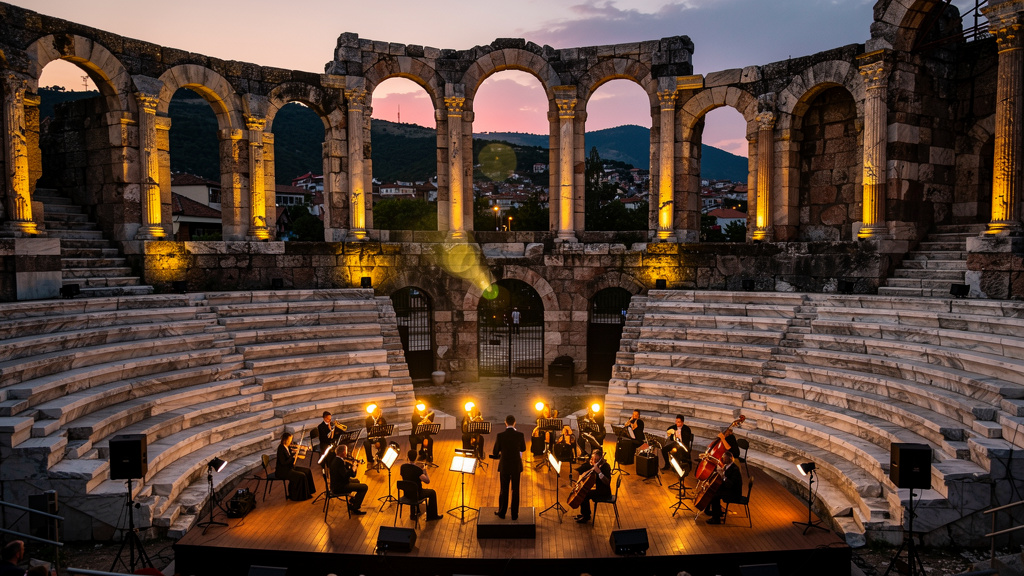
The 2nd-century Roman amphitheatre cut into Plovdiv’s central hill is the kind of monument most European cities would build a museum complex around and charge €25 to enter. In Plovdiv, you walk past it to get to the bus stop. The marble seating tiers still hold 4,000 people. The acoustics are still the ones the Romans designed for. And every June, the city opens it up for an eleven-week open-air opera season — the kind of event programme that would cost €200 a ticket in Verona and costs €25 here.
Opera Open 2026 runs 23 June through 9 September. Sonya Yoncheva opens the season with the Thracian Awards gala on 23 June. Carmina Burana plays as the festival-opening concert on 25 June. The headline programme runs through a Krakow-Plovdiv co-production of Nabucco (4 July premiere), the Bulgarian premiere of Rossini’s Semiramide (11 July), La Traviata (18 July), Aida (25 July), a Queen symphony night at the amphitheatre (24 August), Carmen (28 August), Swan Lake (4 September) and closes with a second Carmina Burana on 9 September. The Bulgarian News Agency’s confirmation piece is the cleanest English-language source on the casting and the two world-class premieres.
That is the festival. The city it sits inside is the rest of the story.
Where Plovdiv has been
Plovdiv is, by most archaeological readings, one of the oldest continuously inhabited cities in Europe — settled by the Thracians in roughly 4000 BC, taken by Philip II of Macedon (who renamed it Philippopolis for himself), conquered by Rome, Christianised in the 4th century, ruled in turn by Byzantines, Bulgarians, Crusaders and Ottomans, and finally restored to Bulgarian rule in 1885. The accumulated architecture is layered into the seven hills that the old town climbs over. The Romans built the amphitheatre and a stadium; the Bulgarian National Revival of the 19th century filled the slopes with extravagant merchant mansions in painted wood and stucco; the 20th century added the elegant collapse of Soviet planning, and then the 21st century has spent the last fifteen years lovingly reinventing the old tobacco warehouses as galleries.
The result, as Time Out’s recent piece argues, is the most underrated city in Europe. Nomadic Matt’s 2026-updated guide backs the case up with budget breakdowns — Plovdiv runs at roughly half the cost of Krakow, and a third of Vienna, for a cultural offer that is honestly comparable. Lonely Planet’s two-day weekend itinerary is the structural reference if you have a short trip.
The Roman city you walk through
The amphitheatre is the headline. The hidden archaeology underneath is the better story. The Ancient Stadium of Philippopolis once seated 30,000 people for chariot races and gladiatorial games — and most of it is still buried beneath Plovdiv’s main pedestrian shopping street. You can see the curved northern end through a glass viewing platform in the middle of the modern Knyaz Aleksandar I avenue, with shoppers walking past on either side.
Two minutes downhill, the Bishop’s Basilica of Philippopolis reopened in 2021 as a museum complex over the 4th-6th-century early-Christian floor mosaics — 2,000 square metres of in-situ tilework, the largest such ensemble surviving in Europe. The intricate floor patterns alone justify a 90-minute visit. The walking distance between amphitheatre, stadium and basilica is under fifteen minutes.
The old town and the sunset hill
Above the Roman city, the Bulgarian National Revival mansions climb the slopes of Sahat Tepe and Nebet Tepe. The cobbled streets are steep — comfortable shoes essential — and the houses are gloriously over-built: cantilevered upper storeys in carved walnut, painted ceiling roses inside, walled courtyards with mulberry trees. An Old Town walking guide from Lost in Plovdiv — the city’s leading independent online guide, locally authored — is the right primer.
The ritual at the top of the hill is sunset drinks on Nebet Tepe. A glass of red Mavrud, the bench at the highest point, the view down over the amphitheatre and the Maritsa river plain stretching off toward the Rhodope Mountains. The same piece names the bar terraces around the climb where you can sit a few benches lower if Nebet Tepe is crowded.
Kapana, the creative quarter
Plovdiv was the European Capital of Culture in 2019, and Kapana — “the mousetrap” — was the flagship project that came out of the year. Eight blocks of formerly derelict workshops between the amphitheatre and the river were renovated into a continuous street of bars, galleries, independent designers and craft beer rooms. Lost in Plovdiv’s deep-dive on Kapana is the best independent guide.
Six years on, the district has evolved past its launch hype into something more lived-in. The bars are mostly still good. The designers and ceramicists keep open studios. The food scene is concentrated here and the early evenings are when Kapana feels best. Rick Steves did a Travel Bite on it (linked below) which is the cleanest two-minute video introduction.
Where to eat
The cuisine is Balkan-Mediterranean — Greek warmth, Turkish technique, an aggressively local emphasis on tomato, white cheese, charcoal-grilled meat and the unbeatable summer staple of shopska salad. Authentic Food Quest’s seven-restaurant Plovdiv shortlist is the curated list — Pavaj in Kapana for relaxed modern Bulgarian, Rahat Tepe for the classic old-town terrace, Hemingway for the Kapana fine-dining angle. TasteAtlas’s Plovdiv page cross-references the headline dishes with where to actually find them — banitsa for breakfast, shkembe chorba for the hangover, kavarma as the main-event meat-and-vegetable casserole. A 50-strong Bulgarian food primer is the wider-context piece if you want the cuisine straight before you arrive.
The wine is worth taking seriously. The Thracian Valley is one of Europe’s oldest wine regions and the local Mavrud, Rubin and Melnik 55 varieties are widely available across Kapana’s wine bars at €4-6 a glass.
Bedding down in the Old Town
The Old Town is where you want to be. Hotel Hebros — a 200-year-old Revival mansion turned boutique hotel, with a 400-label wine list — is the property the city’s serious-cultural-week visitors return to. Boutique Hotel Boris Palace is the alternative — restored 19th-century mansion, panoramic restaurant terrace, period furniture. A wider boutique round-up covers Mediq Old Town and Hotel Evmolpia, the smaller-scale options for travellers on a budget that still wants character.
For the extension trip, Boutique Hotel Tsarevets sits 50 metres from the Tsarevets Fortress in Veliko Tarnovo with a panoramic terrace over the medieval citadel.
The Sofia day-trip and the Veliko Tarnovo overnight
Sofia is 145 kilometres away and the BDZh trains take 2 hours 40 minutes — a comfortable day-trip if you want to see the Bulgarian capital and the Alexander Nevsky Cathedral. Most visitors do the city stopover at the start or end of the trip rather than as a side-trip from Plovdiv.
The better extension is east: Veliko Tarnovo, Bulgaria’s medieval capital, 220 kilometres from Plovdiv (a 3-hour drive). National Geographic’s 24-hour guide is the structural reference — the Tsarevets Fortress, the Asenova quarter, the Sound-and-Light show on the citadel walls. Two nights here on top of three in Plovdiv makes for the cleanest one-week Bulgaria plan.
The landscape, on screen
Two videos that capture Kapana and the city’s wider Roman architecture:
Plovdiv, Bulgaria: Mousetrap District
Rick Steves' Europe
Plovdiv Bulgaria — Europe's Oldest City? Roman Theatre, Stadium & Food Tour
Travel Vlog
From Sofia, by train
Sofia is the international airport. The 2-hour 40-minute train from Sofia Central to Plovdiv runs hourly through the day and costs around €10. Direct flights to Sofia from most European hubs make the round-trip easy. Opera Open tickets go on sale on operaplovdiv.bg in March — the Queen-symphony night and the Carmina Burana opening are usually the first to sell out.
Five weeks until the Opera Open 2026 opening night at the Roman amphitheatre. Carmina Burana on 25 June and the Nabucco premiere on 4 July, the Bishop’s Basilica mosaics, Kapana sunset drinks on Nebet Tepe, the Old Town Revival mansion hotels and a Veliko Tarnovo medieval-capital overnight — all gathered in our Plovdiv collection. Save it before the headline opera nights sell out and the Hebros mansion rooms book through August.
Curated using Epic Itineraries. Log in to save this collection to your own plan.