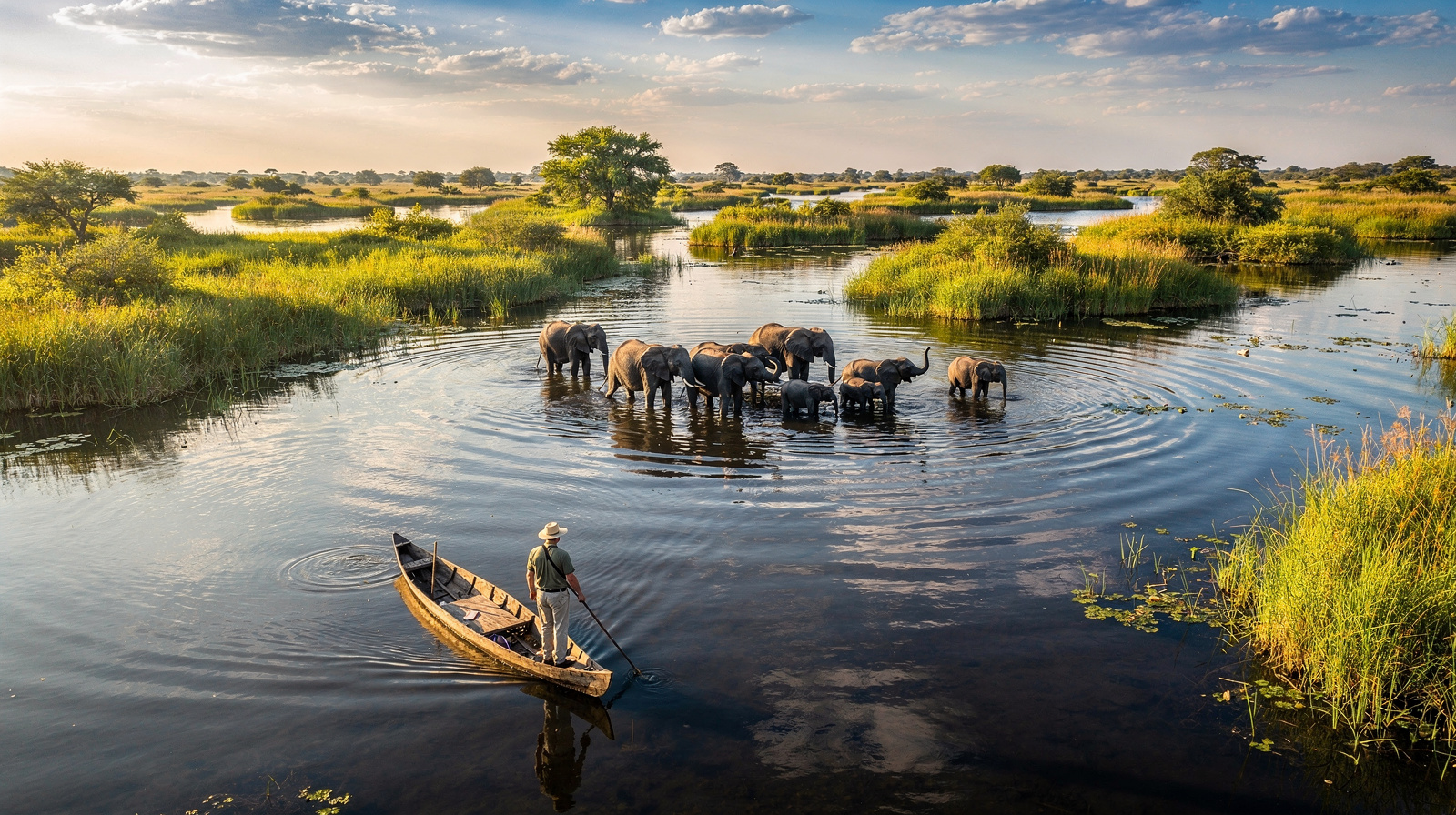
Every winter, a river that never reaches the sea fans out across the Kalahari and builds a wetland the size of a small country — then hands it to elephants, lions and about 400 species of birds. That is a normal year in the Okavango. 2026 is not a normal year. After exceptional rains in the Angolan highlands fell on ground already saturated from 2025, the flood now spreading through the delta is one of the largest in living memory — Africa Geographic reports water reaching channels “only the elders in local communities remember seeing filled”. Right now, in July and August, it is at its peak.
What a flood year actually means
The numbers are startling. In a typical season the delta’s permanent wetland covers around 6,000 square kilometres; forecasts for 2026 put this year’s inundation at anywhere from 15,000 to 22,000 square kilometres, with Lake Ngami — dry-edged since 2011 — expected to fill again. Wilderness’s high-water briefing tracked the floodwater advancing roughly a hundred metres a day through autumn, and the seasonal overview at okavangodelta.com recorded rainfall at more than double the usual amount across much of the catchment.
The paradox that makes this magical: peak water arrives in the bone-dry season. July is cool, cloudless and rain-free, so the delta becomes an oasis in a parched landscape and wildlife concentrates along the water. A month-by-month guide confirms July as the flood’s maximum extent, with August bringing the barbel run — a churning, feeding-frenzy migration of catfish and the birds that chase them, and one of Africa’s least-known great spectacles.
By mokoro, by boat, from the air
A flood year rewards travelling the delta the old way. The mokoro — a dug-out canoe poled through the channels by a local guide — is the defining Okavango experience, and this explainer of how mokoro safaris work captures why: you sit at water level, silent, eye to eye with kingfishers and painted reed frogs, while elephants cross the channel ahead. In 2026, routes that have been too shallow for years are navigable again.
Then there is the view from above. The delta’s scale only makes sense from the air, and Helicopter Horizons flies doors-off photographic flights out of Maun and the camps; the current flight menu starts at US$335 per person for 45 minutes, which sounds extravagant until you are banking over a herd of buffalo strung across a flooded plain.
Moremi and the drylands
Water is only half the story. Moremi Game Reserve protects 5,000 square kilometres of the eastern delta and is rated among the best reserves in Africa, with July to October flagged as its prime window — big cats, wild dogs and some of the continent’s densest elephant country. If you would rather drive it yourself, a Botswana self-drive guide walks through the classic Moremi–Khwai–Savuti–Chobe route, the 4×4 you genuinely need, and how the campsite booking system works.
The lodging question
Botswana runs a deliberate low-volume, high-value tourism model, and the delta’s camps are priced accordingly. At the top end, the editor’s guide to the best Okavango lodges for 2026 tiers them honestly — from legendary Mombo to boutique owner-run camps from US$480 a night — while this round-up of ten standout camps matches each to a travelling style, water-based or mixed. Duba Plains, a five-suite camp in a private northern concession, is famous for its lion–buffalo standoffs and its conservation record.
Realistic budgeting matters here: a current cost breakdown puts mid-range safaris at about US$650 per person per day. But the delta is not only for the lodge crowd — a budget guide to the Okavango shows how wilderness campsites, shared mokoro trips and boat hire from about $40 an hour bring it within reach, and Maun’s best-value stays make the gateway town a decent base for day trips. For trip-shape and logistics, this 2026 Okavango travel guide covers the light-aircraft hops and why three to five days in the delta is the sweet spot.
Watch first
Two films that show what the flood does:
Animal Survival in the Okavango: The Flood — Nat Geo Animals
Nat Geo Animals
This Is What a Safari in Botswana Is Really Like | Okavango Delta & Savuti
Nina Defilla
From Maun
Maun is the delta’s front door: direct flights arrive from Johannesburg and Cape Town, and from there it is a ten-seater Cessna or a helicopter into camp. Non-resident park fees for Moremi run to about BWP 500 per person per day, and the town itself is worth a night — seven good places to eat in Maun covers the farm stalls and riverside spots where safari guides actually have breakfast.
The water is at its highest now and recedes through spring; a flood like this may not come again for a generation. Mokoro operators, the Moremi drylands, doors-off flights and camps from backpacker Maun to Mombo — it is all in our Okavango Delta collection. Save it, compare the camps, and be poled through a channel the elders thought they had seen for the last time.
This guide was curated using Epic Itineraries — save links from anywhere on the web and turn your travel research into organised, shareable collections.