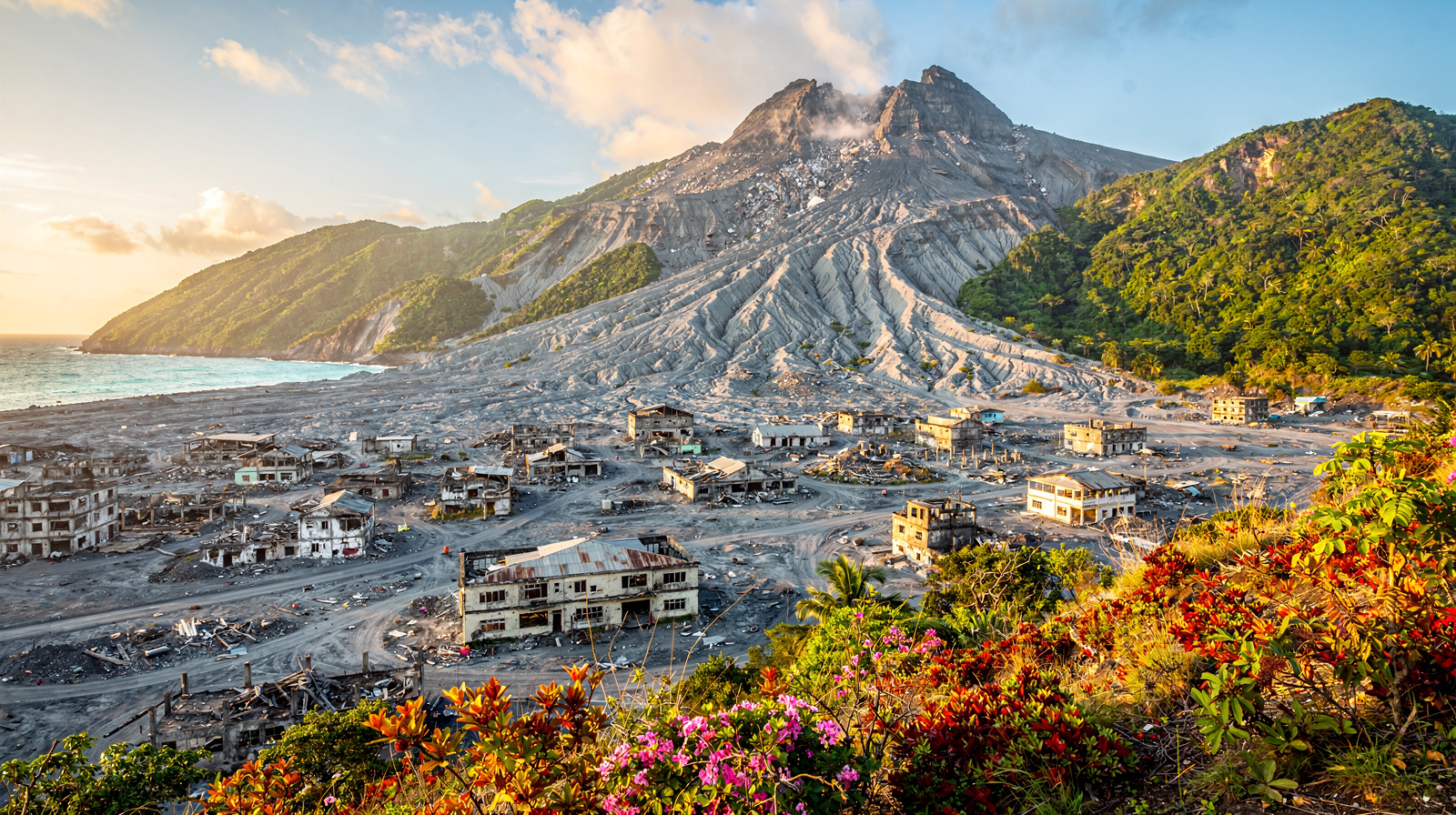
From Garibaldi Hill you look down on what was once the capital of Montserrat. Plymouth lies half-buried in grey volcanic mud: rooftops, the upper floors of shops and offices, and above it all the broken dome of the Soufrière Hills volcano, still steaming. Turn round and the north of the island is green to the summits, and at five in the morning on Boxing Day, the village of Salem will be dancing in the street for J’ouvert.
That contrast is the reason to go. Montserrat is a British Overseas Territory about 13 miles long, with roughly 5,000 people, and very few visitors. Lonely Planet put it in Best in Travel 2027, calling it one of the Caribbean’s most overlooked islands. Its own long guide to the island, written by Nerissa Golden, a Montserratian and editor of Discover Montserrat, is the best introduction you’ll find. Hurricane season is over by December, and the Festival is on.
Four weeks of Festival
The year-end Festival has been held since 1962, and this year it is called Montserrat Festival again after several years as “Carnival”. The 64th edition runs from 4 December to 1 January, and Discover Montserrat has the full calendar. Calypso eliminations open the programme on 4 December, with the official opening and the Festival of Lights the next day. The Seafood Fest in Little Bay is on 20 December.
The big nights come in the final week. J’ouvert starts at 5am on Boxing Day in Salem. The Calypso Monarch final is on 29 December and Queen of Queens, the regional women’s calypso competition, on the 30th. New Year’s Eve is Festival Day, a public holiday with the Children’s Festival in the afternoon. Most visitors miss one detail: the Street Parade and Last Lap aren’t on the 31st but at 2pm on New Year’s Day, from Festival Village in Little Bay. Plan to stay through 1 January.
Calypso runs deep here. Arrow, who released “Hot Hot Hot” in 1983, was Montserratian, and in 1979 George Martin built AIR Studios on the island. Dire Straits, The Police, Elton John and the Rolling Stones all recorded there, and Paul McCartney and Stevie Wonder made “Ebony and Ivory” there, until Hurricane Hugo wrecked the studio in 1989.
The volcano, at a safe distance
The Soufrière Hills woke in July 1995 after about 400 years asleep. Over the next 15 years, eruptions left two-thirds of the island uninhabitable, and more than half the population left. A pyroclastic flow killed 19 people in June 1997. The volcano has been largely quiet since 2010, and the latest weekly report from the Montserrat Volcano Observatory puts the hazard level at 1, the lowest. Plymouth itself is still in Zone V, where there’s no public access.
You can go in only with a certified guide, on a tour that the island’s disaster agency approves in advance. Scriber’s Adventures runs one into the buried city. James “Scriber” Daley, its founder, was made an MBE in 2025 for his work on the island’s nature and tourism. St George’s Hill, closed for nearly 30 years, reopened last November, also with a guide only. With no permit at all, you can take a taxi up to Garibaldi Hill for the view in the opening paragraph, or walk up Jack Boy Hill, which looks over the Tar River Valley and the old airport buried under ash. The observatory at Flemmings shows a 20-minute film about the eruption, and from its grounds you can see the ruins of AIR Studios.
For context before you go, the National Museum in Little Bay has photographs of Plymouth before the eruption and the costumes of the masquerade dancers. It’s open from Thursday to Saturday, and a ticket costs EC$10.
The green north
The beaches are black or grey volcanic sand, with one exception. Rendezvous Bay, the only white-sand beach, can’t be reached by road. You walk 30 to 50 minutes each way over a steep, shadeless saddle from Little Bay, or you rent a kayak from Scuba Montserrat. At Woodlands you can snorkel the reef, and turtles nest there until December. Isles Bay is the easy swim, with a beach bar. None of the beaches has lifeguards.
Inland, the Centre Hills are rainforest. The Oriole Walkway is the island’s most popular trail, about two hours each way to Lawyer’s Mountain. With a guide from the National Trust or Scriber, you have a good chance of seeing the Montserrat oriole, the black-and-yellow national bird found nowhere else. Walk with a guide on every trail, wear long trousers, and carry more water than you think you’ll need.
Goat water on a Friday
The national dish is goat water, a thick, peppery stew of ram goat served with bread or rice. It’s a Friday lunch, and it runs out, so go early. The tourism authority’s restaurant list points you to Emerald Rose in St John’s for goat water and souse at the weekend, to Summer Breeze in Little Bay for rotis and a Killa Bee rum punch, and to Olveston House for its Wednesday-night buffet. Look out for duckna, a sweet-potato and coconut dumpling steamed in a banana leaf, and black cake at Christmas. On a Saturday morning, the Hilltop Coffee House in St Peter’s serves waffles among AIR Studios memorabilia and screens a documentary about the eruption.
The landscape, on screen
The Modern City That Was Buried By a Volcano
PBS Terra
LIFE ON MONTSERRAT: WHAT IT'S REALLY LIKE TO LIVE ON A CARIBBEAN ISLAND
Andy Explores the World
Where to base yourself
Stay in or near Little Bay. Festival Village, the museum, the Marine Village bars and the Rendezvous trail are all there, and the airport and Brades are a few minutes’ drive away. After a calypso final that ends past midnight, that short drive home matters.
Tropical Mansion Suites in Sweeney’s is the most hotel-like option on the island: 16 rooms, a pool and a restaurant, run by a family. Gingerbread Hill in St Peter’s is the good-value pick, with self-catering rooms and a mini-cottage run by the Lea family, who also own the Hilltop Coffee House. There’s a three-night minimum, and Festival dates book up to a year ahead. Olveston House has six rooms in a garden looking towards the volcano. The house once belonged to George Martin of AIR Studios.
Getting there and back
There’s no ferry. The service from Antigua stopped in April 2024 and hasn’t been replaced. FlyMontserrat flies from Antigua every day, about 20 minutes, and WINAIR flies from St Maarten a few times a week. The planes are small with strict weight limits, and checked bags sometimes come on the next flight, so pack essentials in your hand luggage and allow for a night in Antigua if the weather turns. Before you fly, fill in the online arrival form at least 48 hours ahead. British visitors don’t need a visa, and the FCDO’s entry page has the details. You drive on the left and need a temporary driving permit (US$18). The currency is the Eastern Caribbean dollar, US dollars are widely accepted, and there’s only one bank, so bring cash.
Under six weeks until the calypso eliminations open, and a tiny island’s worth of beds for the last week. The day-by-day Festival calendar, Scriber’s guided tour into Plymouth, the Oriole Walkway and Gingerbread Hill and Olveston House are all in our Montserrat collection. Save it, book the hop from Antigua, and be in Salem by five on Boxing Day morning.
This guide was curated using Epic Itineraries — save links from anywhere on the web, organise them into collections, and turn research into itineraries.