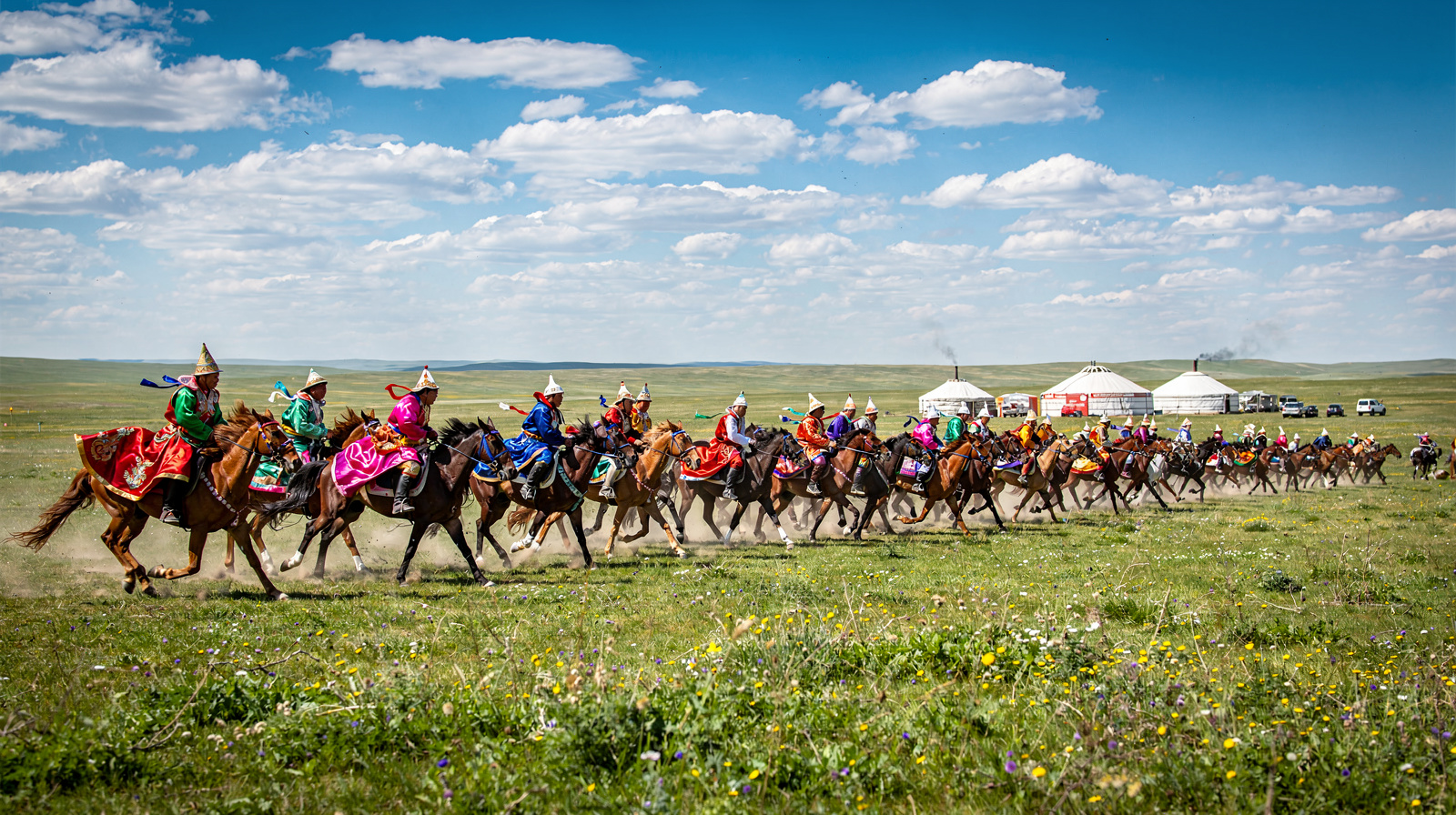
At eleven o’clock on the morning of 11 July, nine white horse-tail banners are carried on horseback from the parliament building into the centre of Ulaanbaatar’s National Central Stadium. The banners — the tug — have stood for Mongolian sovereignty since the time of Chinggis Khan, and their arrival opens Naadam, the festival the country has held in some form for eight centuries. For three days the capital empties its offices and fills its stadium, the surrounding steppe turns into a fairground, and the whole of Mongolia turns its attention to wrestling, archery and the longest horse races you will ever watch. In 2026 it runs from 11 to 13 July, and it is the single best reason to point yourself at one of the emptiest, strangest, most cinematic countries on earth.
Mongolia is a place of three million people and roughly the same number of horses, spread across a landmass the size of western Europe with almost no fences in between. The festival itself — eriin gurvan naadam, “the three games of men” — is recorded in the 13th-century Secret History of the Mongols and has been on UNESCO’s intangible-heritage list since 2010; Wikipedia’s Naadam entry is the cleanest single explainer of how the three disciplines actually work. Before you commit to dates, read Lonely Planet’s 17 things to know before travelling to Mongolia — it is honest about the things that catch first-timers out, chiefly that this is a cash economy the moment you leave the city, and that you should have a July trip booked by March.
The three games of men
Wrestling is the heart of it. Hundreds of bökh wrestlers — a single-elimination field that can run to 512 or 1,024 men — grapple in heavy boots and tiny open-fronted jackets until one of them touches the ground with anything but his feet or hands. Win deep enough into the rounds and you earn a title that stays with you: zaan, elephant, then arslan, lion, and for a two-time champion, avraga, titan. Archery sits alongside it, teams of ten loosing arrows at a low wall of woven-willow cylinders called surs — the men shooting from 75 metres, the women from 65.
The horse racing is the part nobody is prepared for. These are not laps of a track but cross-country endurance races of 15 to 30 kilometres across open steppe, graded by the age of the horse, and ridden by child jockeys between five and thirteen years old, very often bareback. They run at Khui Doloon Khudag, about 30 kilometres west of the city, and — unlike the stadium events — they are free to attend. For the timings, the ticketing and where to actually stand, the locally written Naadam 2026 insider guide from Atlas Mongolia is the one to trust: it lays out the eleven o’clock opening, the opening-ceremony tickets that start around $25 and sell out months ahead, and the fact that the archery and racing cost nothing.
Beyond the stadium: the steppe and the Gobi
Naadam is the anchor, not the whole trip. Most people spend three or four days on the festival and a week or more on the country around it. The easy first move is east into Terelj National Park, an hour or so from the capital, where Turtle Rock, the cliff-side Aryabal Monastery and the colossal Chinggis Khan equestrian statue make a comfortable introduction to ger life without a long drive.
The bigger ambition is the Gobi. It is not the sea of dunes people imagine but a vast, varied desert of grassland, gravel and rock — the Khongoryn Els “singing” dunes rising as high as 300 metres, and the rust-red Flaming Cliffs at Bayanzag, where the first fossilised dinosaur eggs were found in the 1920s. Meanwhile in Mongolia’s guide to the Gobi is the realistic planner — it gives you a workable ten-day route, strings the marquee stops into a drivable line, and is candid that July and August heat can touch 40°C. Travellers with more time head the other way, north to Lake Khövsgöl, the 136-kilometre “Blue Pearl” near the Siberian border; this Khövsgöl guide covers the fly-in via Mörön and the multi-day horse treks out to the Tsaatan reindeer herders.
Buuz, khuushuur and a bowl of airag
Mongolian food is built for a cold, mobile, meat-and-dairy life, and Naadam has its own dish. Khuushuur — flat, deep-fried mutton pastries — are so bound up with the festival that locals will tell you that you haven’t really done Naadam until you’ve eaten one off a steppe-side griddle. The everyday staple is buuz, steamed dumplings folded by the dozen, and the drink you should at least attempt once is airag, lightly fizzy, sharply sour fermented mare’s milk. In the city, an eight-year Ulaanbaatar resident’s shortlist of where to eat points you from the reliable Modern Nomads and Khaan Buuz halls to Altan Gadas, where dinner comes with throat-singers and the horse-head fiddle; Koryo Tours’ restaurant rundown is the back-up list for the festival days, when the capital is at its fullest.
A bed in the city, a ger on the steppe
Sleeping during Naadam is a two-part problem. In town you want something central and booked early — the guides warn that city hotels sell out four to six months ahead and lift their rates steeply over the festival. The Kempinski Hotel Khan Palace, a short walk from Sükhbaatar Square, is the dependable five-star base; you can check live availability and rates on its Booking.com page. Out in the country, the bed becomes the point of the trip. Three Camel Lodge, in Gobi Gurvansaikhan National Park, is the flagship: forty handcrafted gers with private bathrooms and central skylights, a whisky bar called the Thirsty Camel, and bookable journeys that fold in fossil digs and visits to nomad families. Between the two extremes sit dozens of simpler ger camps, in Terelj and beyond, where heated floors and a wood stove are luxury enough under that much sky.
Press play before you fly
Two films do more than any photograph to prepare you. Al Jazeera’s 101 East documentary follows the children who ride the long Naadam races — the most honest, human look at the sport’s beating heart — and Lonely Planet’s Best in Travel film makes the visual case for why the country topped its 2024 list.
Born to ride: Mongolia's child jockeys | 101 East
Al Jazeera English
MONGOLIA: The ULTIMATE Far-Off Road Trip | Lonely Planet's Best in Travel 2024
Lonely Planet
Getting there, and a visa window worth noting
There are no direct flights from the UK; you route through Seoul, Istanbul, Beijing or Frankfurt into Chinggis Khaan International, about 50 kilometres south of Ulaanbaatar, with Turkish Airlines often the cheapest way in. There is one timing detail worth knowing before anything else: for British passport holders, Mongolia is currently visa-free for tourist stays of up to 30 days — but only until 31 December 2026, so a July trip falls neatly inside the window. Distances inland are real and the roads are rough, so most visitors hand the driving to a specialist: National Geographic’s Naadam journey and Intrepid’s small-group festival trip both bundle the stadium with ger-camp nights so you are not arranging drivers and cooks yourself.
Eighteen days until the banners enter the stadium. The opening-ceremony tickets, the free horse races at Khui Doloon Khudag, the Three Camel Lodge gers, the Gobi ten-day route and the Ulaanbaatar restaurant list are all gathered in our Mongolia & the Naadam Festival collection — save it, lock your beds before the festival rates climb, and plan to finish at least one day with a khuushuur in your hand and a bowl of airag you only half-finish.
Curated using Epic Itineraries. Log in to save this collection to your own plan.