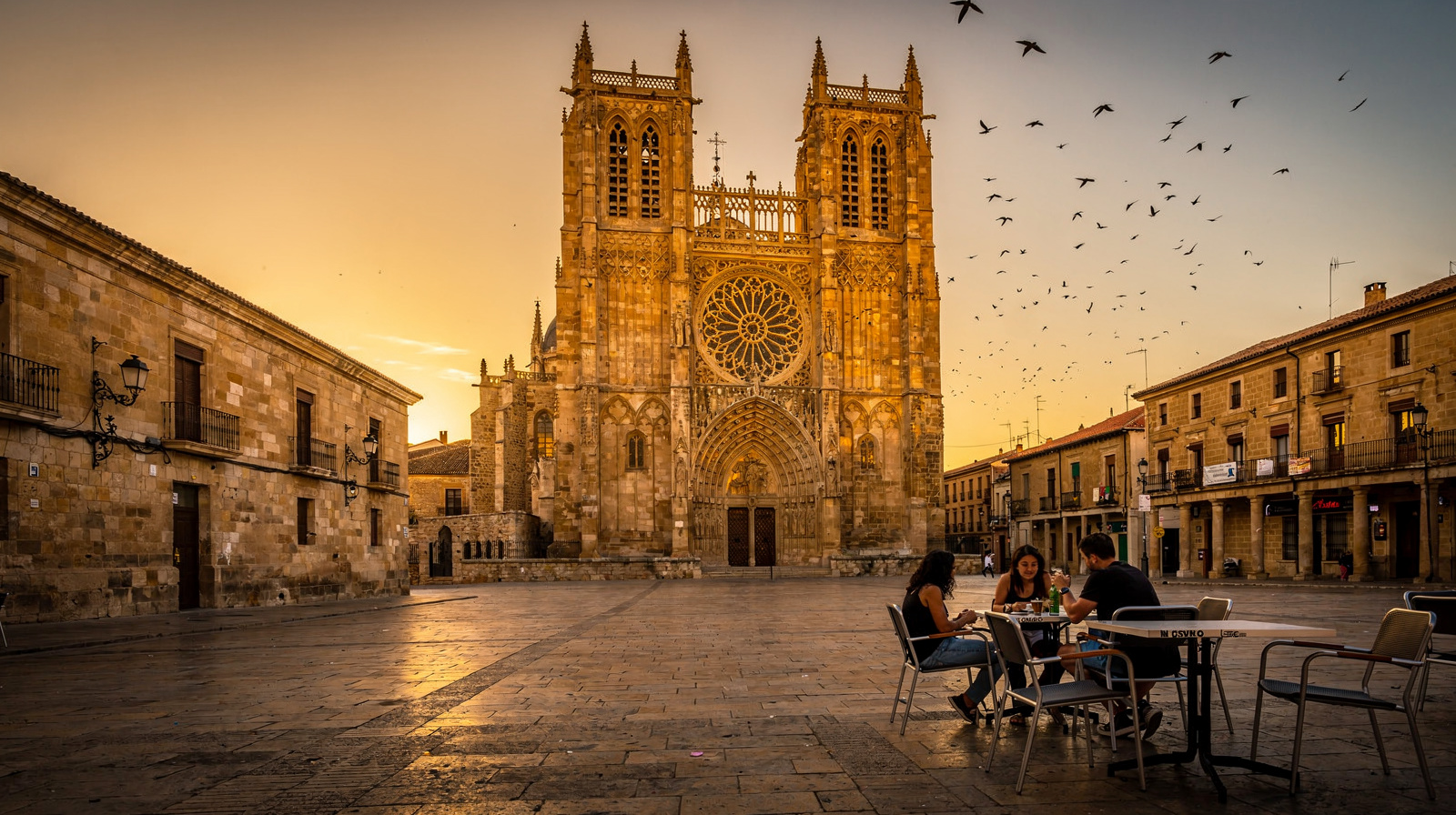
At 20:29 on the evening of 12 August 2026, the sky over León goes dark. Not storm-dark or dusk-dark: mid-eclipse dark, with a black sun hanging ten degrees above the western horizon and the corona flaring around it for one minute and forty-six seconds. It is the first total solar eclipse visible from mainland Europe since 1999 and the first from the Iberian Peninsula in over a century, and León — an underrated Gothic city on the Camino de Santiago that most travellers have never given a weekend — sits almost exactly on the centreline. For one evening, a quiet provincial capital of stained glass and free tapas becomes one of the best places on Earth to stand.
The mechanics are worth understanding before anything else, because this eclipse is unusual. Spain’s official mapping at the Instituto Geográfico Nacional shows the shadow sweeping from A Coruña through León and on towards Zaragoza and the Balearics — but late in the day, with the sun already sinking. That low sun is both the drama and the catch. Space.com’s practical warning piece is blunt about it: a building, a hill, even a line of poplars on your western horizon can hide totality entirely. Pick your spot with a clear view west, scout it in daylight, and be standing on it two or three hours early.
Two minutes at half past eight
The good news is that the odds of clear sky are about as good as this eclipse offers anywhere. Veteran eclipse meteorologist Jay Anderson’s climatology of the 2026 path gives the Castilla y León plateau 68–78 per cent of possible August sunshine — satellite records suggest the eclipse would have been visible from here in 17 of the last 21 years. That is why the serious eclipse-chasing community settled on this stretch of the meseta long ago, and why viewing guides for the region keep repeating the same advice: the plateau’s wide, flat, west-facing horizons are exactly what a sunset totality needs.
In the city itself, the local viewing guide points to the Bernesga riverside parks and west-facing rooftops; out in the province, the best villages for totality include Riaño, where the reservoir and peaks do a passable impression of a fjord, and La Cueta, the highest village in the province. And there is a proper institutional anchor for the day: the European Space Agency is co-hosting a free public eclipse event in León — science workshops in the morning, expert commentary through the evening observation, and free certified eclipse glasses while stocks last. No registration, no ticket. Just turn up.
The House of Light
It would be a mistake to treat León as a car park for the eclipse, because the city has been staging light shows since the thirteenth century. León Cathedral — the Pulchra Leonina, nicknamed the House of Light — holds nearly 1,800 square metres of stained glass, the great majority of it original medieval work. Walk in mid-afternoon and the nave swims in reds and golds; this photo-led study of the windows makes a persuasive case that the ensemble outshines Sainte-Chapelle in Paris. Ten minutes away, the Royal Pantheon at San Isidoro earns its “Sistine Chapel of Romanesque art” billing with ceiling frescoes that have barely faded in nine centuries — and a museum holding the Chalice of Doña Urraca, which some researchers have linked, with commendable Spanish confidence, to the Holy Grail.
The third heavyweight is a surprise: Gaudí, a long way from Barcelona. Casa Botines, his castle-like 1893 building two blocks from the cathedral, is one of only three Gaudí works outside Catalonia and now a museum with rooftop tower access for a few euros more. For orientation across all of it, Daniel James Clarke’s weekend guide is the most polished plan of the city, and Brogan Abroad’s rundown adds the Roman and Camino layers. With a spare day, drive west to Las Médulas, the UNESCO-listed landscape the Romans left behind after hydraulically demolishing a mountain range for its gold — red spires rising out of chestnut forest, best seen from the Orellán viewpoint.
A free tapa with every drink
León is one of the last Spanish cities where the old covenant holds: order a drink, receive food, pay for neither separately. The medieval quarter is called the Barrio Húmedo — the “wet quarter”, for the density of its taverns — and the custom is movement: one drink and one tapa per bar, then on to the next. The bar-by-bar crawl guide has the essentials: El Rebote for croquettes in unreasonable flavours, La Bicha for morcilla, Rincón del Gaucho for garlic soup. The two things to order by name are cecina — smoked, air-cured beef with protected status, deeper and darker than jamón — and morcilla de León, an onion-heavy blood sausage locals treat as a birthright. This food-first guide argues the city is Spain’s most underrated on the strength of its plates alone, and after two evenings in the Húmedo the argument tends to win itself. Tapas hours run roughly 13:00–15:30 and 20:00–23:00 — which means on eclipse night, totality lands neatly between vermouth and dinner.
The lodging question
Here is the honest part: the whole path of totality has been booking out for a year, and the numbers are startling — rental searches along the corridor up 830 per cent, up to ten million visitors expected, and rural stretches where holiday lets outnumber hotel beds forty to one. The prize address, the Parador de León in the 16th-century San Marcos monastery — a former pilgrim hospital with a Plateresque façade and a west-facing river terrace — is the sort of place that sells out in ordinary Augusts. But cancellations happen, the wider León hotel shortlist runs deeper than the headlines suggest (including rooms inside the San Isidoro complex itself), and León has an escape hatch other eclipse towns lack: the train. Direct Renfe services from Madrid reach León in as little as two hours, around thirteen times a day, which makes an eclipse day trip from the capital entirely workable — go up mid-morning, cathedral in the afternoon, tapas at eight, totality at 20:29, late train back.
A few minutes of footage
The city at walking pace, and the eclipse path explained:
Walking tour León | Spain [4K]
Tatiana Zappa
Total Solar Eclipse 2026 in Spain: Where to Watch and Best Viewing Locations
Natural Portraits Global
Sixteen days. That is what stands between this article and the moment the lights go out over the meseta — and the next total eclipse over mainland Spain won’t wait long (2027 grazes the south), but it won’t have León’s centreline, its stained glass or its free morcilla. The viewing guides and timings, the ESA event, the Barrio Húmedo crawl, the Parador and the Las Médulas detour are all gathered in our León eclipse collection — save it, sort your west-facing spot and your train ticket, and be standing on the Bernesga at 20:29 when the corona comes out.
Curated using Epic Itineraries. Log in to save this collection to your own plan.