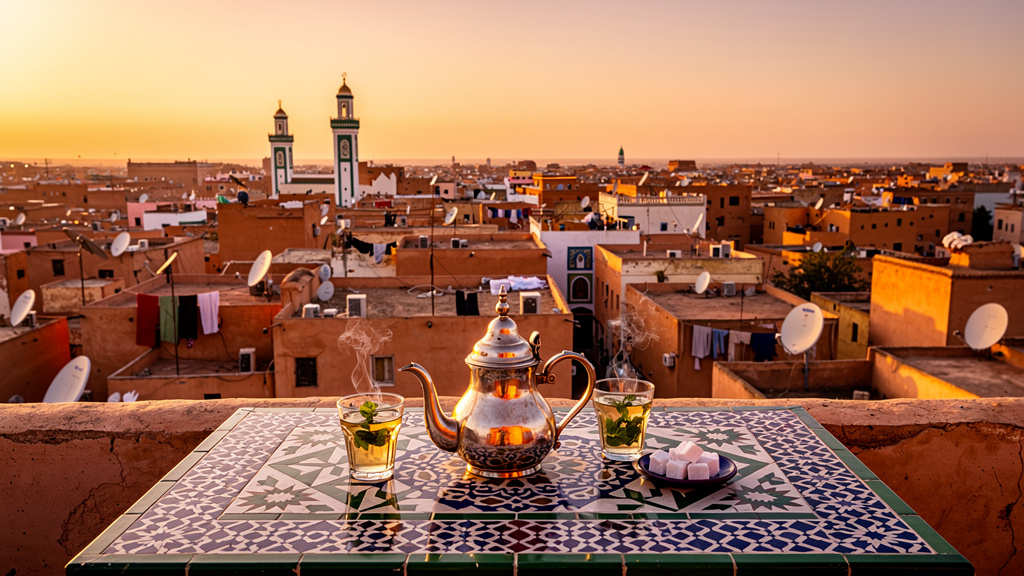
You’ll be lost within fifteen minutes. Properly, completely, deliberately lost.
The alleyway narrows to shoulder-width. Sunlight disappears somewhere overhead, blocked by buildings that lean toward each other across the gap. A donkey loaded with mint leaves brushes past, followed by a man carrying a tower of fresh bread on his head. The GPS on your phone shows a grey void — the satellite can’t see through the maze, can’t make sense of the nine thousand passageways that comprise the Fès el-Bali medina.
This is the largest car-free urban zone in the world. It’s been a UNESCO World Heritage Site since 1981. And despite decades of travellers “discovering” Morocco, it remains genuinely, wonderfully overwhelming in a way that Marrakech’s now-polished medina cannot match.
Condé Nast Traveller named Fès to their 2026 destinations list, which feels simultaneously obvious and overdue. For years, Morocco’s tourism has concentrated on Marrakech, with its Instagram-ready riads and well-worn tourist circuits. Fès requires more from visitors — more patience, more curiosity, more willingness to surrender to confusion. The rewards are proportional.
Why Fès over Marrakech
Skratch makes the case directly: Marrakech has become a victim of its own success. The medina there is still beautiful, still historic, but increasingly managed for foreign consumption. Riads have been converted to boutique hotels. Traditional craftsmen have moved out, replaced by shops selling goods produced elsewhere. The famous Jemaa el-Fnaa square now feels more like performance than spontaneous gathering.
Fès hasn’t undergone that transformation. The medina remains a living, working city — Morocco’s spiritual and intellectual capital, home to the world’s oldest continually operating university (Al-Qarawiyyin, founded in 859 AD), and a place where traditional crafts are still practised because they’re still needed, not because tourists expect them.
This comes with complications. The medina is genuinely difficult to navigate. Touts can be persistent (though less aggressive than Marrakech’s). The sensory overload — sound, smell, crowds, heat — exhausts visitors unused to it. National Geographic’s inside guide doesn’t sugarcoat these challenges but frames them correctly: this is immersion, not inconvenience.
Entering the labyrinth
Salt in Our Hair’s visual guide captures what photographs struggle to convey — the density, the layers, the vertical dimension where buildings and balconies create a kind of covered streetscape. The main entrance through Bab Bou Jeloud (the famous blue gate) deposits you into the chaos immediately. There’s no gradual acclimatisation.
The practical advice is universal: hire a guide for your first day. Not because you can’t explore independently — you can, and should — but because a good guide provides context that transforms confusion into comprehension. They’ll explain the logic of the medina’s organisation (neighbourhoods clustered by trade, fountains marking community centres, mosques oriented toward Mecca), point out architectural details you’d miss, and crucially, help you find your way back to your riad when exhaustion hits.
Nomadic Matt’s budget guide recommends hiring through your accommodation rather than accepting offers from strangers at the gate. Good advice. The official guides know the city intimately and have relationships with merchants that eliminate the hard-sell experiences that frustrate many visitors.
After that first orientation, get lost on purpose. Atlas Obscura’s unusual attractions highlight the discoveries waiting down unmarked alleys — hidden gardens, forgotten madrasas, workshops where third-generation craftsmen still produce goods using medieval techniques.
The tanneries: essential spectacle
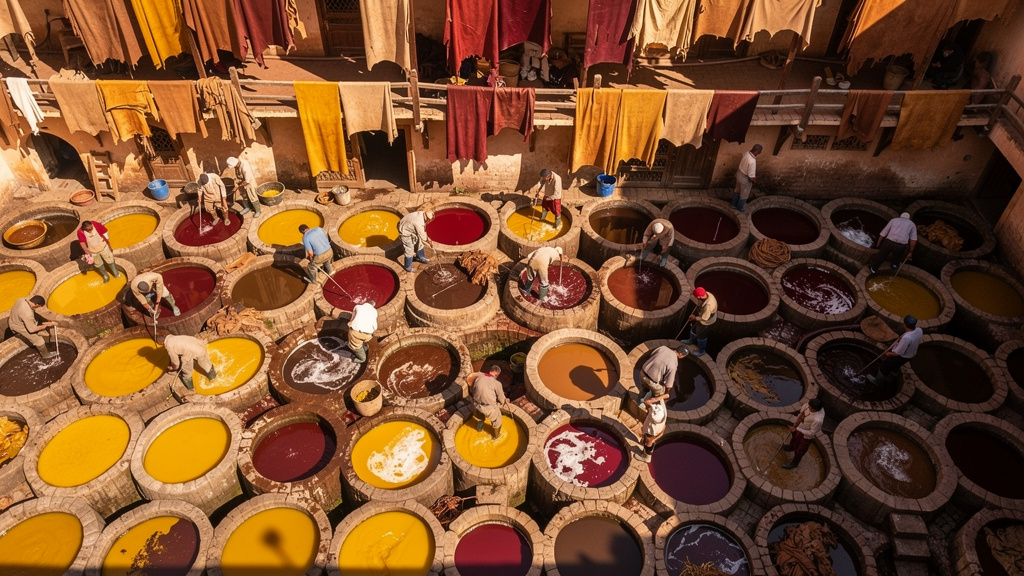
Fès is famous for leather, and the tanneries are famous for being unforgettable in every sense. Passport & Stamps’ practical guide covers the Chouara Tannery, the largest and most photographed. From the terraces of surrounding leather shops (where someone will inevitably try to sell you something), you overlook a honeycomb of stone vats in white, ochre, red, and brown. Men stand waist-deep in dyes made from saffron, poppy, and henna. The smell of the pigeon droppings used to soften the leather is… memorable.
The process hasn’t changed significantly since the 12th century. Neither has the business model — free access to the terraces, with the expectation that you’ll browse the goods and possibly buy something. The leather is genuinely high quality. The prices are negotiable. The mint leaves offered at the entrance aren’t just hospitality; you’ll want them for your nose.
Food in the ancient city
Fès cuisine differs subtly from Marrakech’s. The pastilla (sweet-savoury pastry traditionally filled with pigeon) arguably originated here. The tagines tend toward more complex spicing. And the street food — rfissa, msemmen, harira — is extraordinary and cheap.
Wandering Everywhere’s street food guide maps the medina’s essential bites. Fried fish near the fish market. Honey-soaked pastries in the spice quarter. The snail soup that locals swear cures everything from colds to heartbreak. Nothing costs more than a few dirhams, and nothing disappoints.
For sit-down meals, AFAR’s restaurant recommendations span rooftop terraces with medina views (Ruined Garden, Riad Rcif) to Moroccan fine dining (Restaurant Numero 7) to the kind of unmarked local spots that guidebooks can’t improve because they don’t need foreign customers anyway. Ask your riad for recommendations; they’ll know the family-run places where the pastilla is made fresh and the terrace has been serving dinners since before anyone’s grandfather can remember.
If you want to understand the cuisine more deeply, My Free Range Family’s cooking class review describes the experience of shopping for ingredients in the medina and then learning to prepare them in a traditional kitchen. It’s a good half-day activity and genuinely educational — Moroccan cooking involves techniques (the charcoal kanoun stoves, the long-simmered tagines, the delicate pastry work) that don’t translate easily from recipes alone.
Staying inside the walls
The riad experience is central to Fès. These traditional courtyard houses — rooms surrounding a central garden or fountain, often elaborately tiled and fountained — have been converted into guesthouses throughout the medina. Unique Travel Morocco’s riad guide covers options across budgets.
The choice matters more than in most cities. Location within the medina affects noise levels, rooftop views, and how far you’ll walk through the labyrinth each evening to reach your bed. The better riads provide airport transfers (essential — you won’t find them independently on arrival), breakfast on the terrace, and staff who can arrange guides, excursions, and restaurant reservations.
Expect to pay less than Marrakech for equivalent quality. Fès hasn’t fully caught up with its more famous sibling, which is one of many arguments for visiting now.
Beyond the medina walls
Lonely Planet’s things to do extends beyond the medina to the Ville Nouvelle (the French-built new town, with its own faded colonial atmosphere) and surrounding attractions. The Merenid tombs on the hill above the medina offer the classic panoramic view, particularly at sunset when the call to prayer echoes across thousands of rooftops.
Day trips from Fès can reach Volubilis (Roman ruins that are Morocco’s answer to Pompeii), Meknes (a smaller, calmer imperial city), and the blue-painted mountain village of Chefchaouen — though the last requires a full day and is better as an overnight stop.
The AFAR comprehensive guide is worth bookmarking for practical planning — when to visit (spring and autumn avoid the summer heat), what to wear (conservative dress helps, particularly for women), and how long to stay (three to four days allows proper immersion without exhaustion).
The UNESCO question
The World Heritage Site listing dates from 1981, making Fès el-Bali one of the earliest protected medinas. The designation has brought restoration funding and some regulatory protection, though the medina’s primary preservation mechanism is simpler: it still works.
Unlike historic centres that become museums, Fès remains functional. The tanneries produce leather for local shoemakers. The foundouks (caravanserais) house workshops, not hotels. The mosques fill for prayers five times daily. The streets crowd with residents doing ordinary errands. Tourism exists within this ecosystem rather than displacing it.
How long that balance holds is uncertain. Every “hidden gem” feature article tips the scales slightly. The flight arrivals increase. New riads open. Eventually, perhaps, Fès becomes what Marrakech became — still beautiful, still historic, but performing its authenticity rather than simply living it.
That transformation hasn’t happened yet. The nine thousand alleyways still confuse GPS satellites. The donkeys still carry mint leaves and pottery. The ninety-five-year-old traditions still continue because they still make sense, not because someone decided to preserve them for visitors.
Get lost while you still can.
Ready to navigate the maze? Our Fès collection brings together the best riads, restaurants, and experiences — save it and start planning your medina adventure.