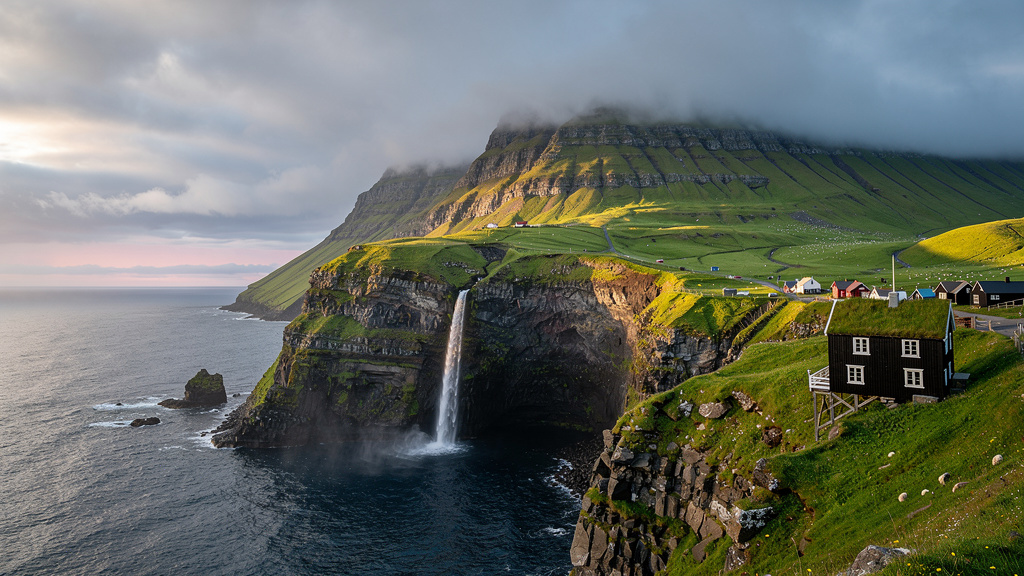
The Faroe Islands have spent the last forty years being the kind of destination travel magazines mention but nobody actually books. Eighteen volcanic islands strung out between Iceland and Norway, capital with a population the size of an English market town, the only Nordic country without a single McDonald’s, and a tourist visitor count that hovered for decades at around 100,000 a year — fewer than a single Mediterranean cruise port handles in a weekend. The combination of distance, expense, and weather kept the place to itself.
Three things have changed that. The Sandoyartunnilin subsea tunnel opened in December 2023, finally connecting Sandoy to the central road network and adding the world’s first undersea roundabout (between Streymoy and Eysturoy) to the islands’ driving experience. Icelandair has been running five to six weekly flights from Reykjavík to Vágar through the summer. And Condé Nast Traveller has, twice in the last two years, named the Faroes one of its 25 best places to go. The combined effect is that the 2026 summer is the last one before the country’s accommodation infrastructure catches up with the new demand.
The window itself is short. Mid-May through mid-July is the only stretch of the year when the inter-island ferries are running their full schedule, the puffin colonies on Mykines are nesting, and the daylight runs to 19 hours — which gives you the rare experience of finishing a 16-kilometre hike at 10 p.m. with the sun still 30 degrees above the horizon. The festival capping the window is the G!, on the second weekend of July.
G! Festival, 16-18 July
The G! Festival — Tónleikaliga Tjóðarhátíð Føroyinga in Faroese — is one of the smallest, most committed music festivals in Europe. It is staged on a black-sand beach in the village of Syðrugøta on Eysturoy, capacity around 5,000, founded in 2002 by local musicians who wanted a Nordic-rock festival that would not have to compete with Roskilde or Iceland Airwaves. The 2026 line-up has Ásgeir, Oliver Tree, Fantastic Negrito and Tamikrest as the international headliners, alongside Faroese acts AySay, Sakaris, Clickhaze, Guðrið Hansdóttir and the perfectly-named Joe & The Shitboys.
The festival’s character matters. The stages are small. The crowd is half-Faroese, half-Nordic-and-international. The line-up runs from Faroese pop and folk through electronic and indie rock and into the occasional heavier band. People bring their own picnic blankets. The local choir sings at the opening. The drinks are reasonably priced. The whole thing is, in a way that surprises first-time visitors, an actual community event rather than a corporate festival product.
A 2024 review at The Line of Best Fit captures the texture better than the official listings. Tickets are released in March and sell out by May for the international acts.
Mykines, the puffins, and a closure to know about
Mykines is the westernmost Faroese island and the only one where Atlantic puffins still nest in large enough numbers to be a destination. Guide to Faroe Islands’ Mykines briefing is the definitive 2026 source, and the most important sentence in it for this year’s travellers is this one: the Mykineshólmur lighthouse path is closed for the entire 2026 summer season, with conservation work ongoing on the islet. You can still hike the public uphill path from the village to the cliff edge and watch the puffin colony free of charge — the experience that everyone comes for — but you cannot cross the cable bridge to the islet or walk to the lighthouse itself. The lighthouse silhouette is the most-photographed Mykines image online, and most travellers expecting it will be disappointed.
The ferry from Sørvágur on Vágar takes 45 minutes and is the de facto puffin gateway. Booking on mykines.fo releases tickets in narrow rolling windows. Plan for a 7-8 hour day on the island, give yourself a backup date in case of fog, and book three weeks ahead from mid-June onward.
Tórshavn, the capital and the food
Tórshavn — population 14,000 — is the smallest national capital in Europe and one of the most photogenic. The Tinganes peninsula, where the Faroese parliament still meets in red-painted timber houses with turf roofs, is the historic centre. Along Dusty Roads’ Tórshavn guide is the right primer — the harbour walks, the Nordic House, the city’s growing café scene, and the way the city’s tiny scale rewards walking everywhere.
The food story is the part that has shifted hardest in the last decade. KOKS, the New Nordic two-Michelin-star restaurant run by chef Poul Andrias Ziska, sits near Lake Leynar on Streymoy with a 17-course tasting menu built from ræst mutton, fermented seabird, glacier-water broths and the foraged shoreline of the islands. The price is real and so is the experience. Booking three to four months out is standard. (Ziska’s second venue, Paz, opened in Tórshavn in April 2025 and was awarded two Michelin stars within weeks — book through his team’s site once you know your dates.)
The traditional counterpart is Áarstova, a 17th-century log house in the Tinganes lanes serving slow-braised Faroese lamb. Ræst is the all-fermented tasting menu in a turf-roofed Tinganes house — ræst mutton, fermented fish, the centuries-old preservation cuisine that the Faroes survived on and have now turned into Michelin-Guide dining.
For the most distinctive Faroese meal of all, Heimablídni is the home-dining programme — a directory of farming and fishing families who open their living rooms for evening meals across the islands. Some are formal, some are loose, all are extraordinary.
A seven-day shape
Along Dusty Roads’ seven-day road-trip itinerary is the cleanest single planning reference. The country is small enough that no inter-island move takes more than 90 minutes by car, and the new tunnel network makes the central islands feel like a single landmass. A standard seven-day shape: arrival into Vágar, two days on Vágar and Streymoy (Gásadalur and Múlafossur waterfall, Tórshavn), one day on Mykines, two days on Eysturoy (Gjógv village hikes, the Slættaratindur summit on a clear day, Saksun if you stretch back into Streymoy), and a final day on Kalsoy for the Kallur lighthouse hike, with G! Festival timing slotting around it.
Lonely Planet’s three Faroes itineraries cover capital-focused, road-trip and island-hopper alternatives. The Common Wanderer’s 22 pre-trip tips is the practicalities piece — weather variability, ferry cancellations, fuel, mobile data and the respectful-behaviour-around-private-land note that has become important as visitor numbers have climbed.
Gásadalur and the Múlafossur waterfall
The single most-photographed image of the Faroes is Múlafossur — a ribbon of water tumbling over a basalt cliff straight into the North Atlantic, with the village of Gásadalur on the cliff edge and the green hills rising behind. Northtrotter’s Gásadalur guide covers both the easy viewpoint approach (a 200-metre walk from the car park) and the longer Postman’s Trail from the village of Bøur over the saddle into Gásadalur, which is the version locals do.
To stay, Múlafossur Cottages — six purpose-built timber cabins a ten-minute walk from the waterfall — is the most photogenic accommodation in the country.
Tórshavn or the cottages at Gásadalur
For Tórshavn, Hotel Hafnia is the four-star city hotel walking distance from Tinganes and the harbour. Hotel Føroyar is the Friis & Moltke design hotel above the city, with a sweeping turf roof and panoramic views over the bay — the architectural pick.
For the mountains, Gjáargarður Guesthouse in Gjógv on Eysturoy is the launchpad for the Slættaratindur summit (the country’s highest peak at 880m) and the village walks down to the harbour notch.
The landscape, on screen
Two videos that anchor the landscape and the road-trip pacing:
Faroe Islands 4K — The Last Paradise on Earth
Travel Documentary
Faroe Islands Road Trip — Vágar & Mykines
Travel Vlog
From Reykjavík or Copenhagen
Vágar Airport (FAE) has direct flights via Atlantic Airways and Icelandair from Copenhagen, Reykjavík, Edinburgh, Bergen and Paris. The new Sandoyartunnilin tunnel charges 175 DKK one-way; the older Norðoyatunnilin and Vágatunnilin are similar. Mykines ferry tickets release in narrow windows on mykines.fo — set a calendar alert if your dates are non-negotiable. The Mykineshólmur lighthouse remains closed for all of summer 2026 — the puffin viewing on the public path is still free and excellent.
Eight weeks until the G! Festival opens on the Syðrugøta black sand. Mykines puffin-boat windows that close three weeks ahead, KOKS and Ræst tasting menus with three-month booking lead-times, Múlafossur cottages on the Gásadalur cliff edge, and the Kallur lighthouse hike at midnight on Kalsoy — all gathered in our Faroe Islands collection. Save it before the festival weekend room rates double and the Sørvágur ferry fills.
Curated using Epic Itineraries. Log in to save this collection to your own plan.