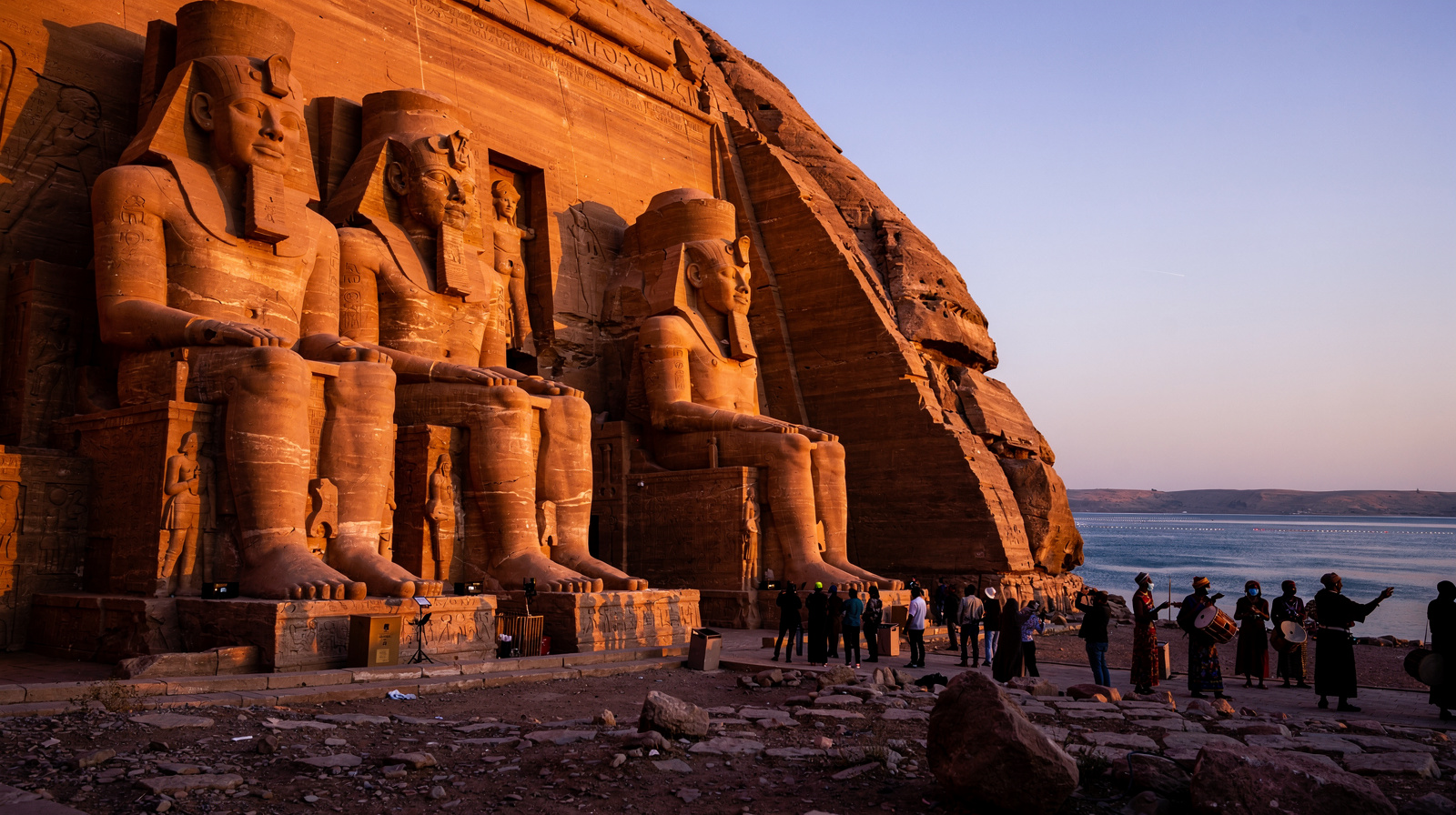
The permitted error was five millimetres. Between 1964 and 1968, with Lake Nasser rising behind the new High Dam, engineers sawed the two temples of Abu Simbel into about 1,035 blocks of twenty to thirty tonnes each, lifted them 65 metres up the cliff and 200 metres back from the water, and rebuilt them inside an artificial hill. They got it right enough that the sun still keeps its appointment. Twice a year, on 22 February and 22 October, the rising sun runs sixty metres down the axis of the Great Temple and lights three of the four seated figures in the sanctuary — Ramses II, Amun and Ra-Horakhty — for about twenty minutes, and leaves the fourth, Ptah of the underworld, in the dark. It was built that way three thousand two hundred years ago.
Because the move shifted the alignment by roughly a day, the crowd now gathers on the 21st as well as the 22nd, and gets much the same result on both. In 2026 Egypt is still on summer time in late October, so sunrise at Abu Simbel is 06:52 and the beam reaches the sanctuary shortly after seven; the Ministry of Antiquities’ site page prices the festival mornings at EGP 1,200 for foreigners, about €20, against 750 on any other day. Ten days later, on 1 November, the Grand Egyptian Museum at Giza turns one. Put the two together and you have the shape of a Nile trip.
Sleep in Abu Simbel, not in Aswan
Almost everyone sees Abu Simbel from Aswan: a police-escorted convoy leaves at half past three in the morning, drives 280 kilometres across open desert and arrives with the day-trippers. Neither puts you at the temple in the dark on festival morning. Exploring Wild’s first-hand guide makes the case for the other way round: sleep in Abu Simbel town, walk to the gates before six with the Nubian drummers already going, and watch the light arrive without a coach schedule behind you. The night before, the sound-and-light show here is widely rated the best in the country. Eskaleh, a family-run mud-brick ecolodge on the lake ten minutes from the temples, is the place, at roughly a hundred dollars a night; book now, because the town has three hotels and the festival dates fill. Egypt’s major sites went cashless this year, so bring a card that works abroad.
Aswan, and the honest version of the Nubian village
Aswan in late October still touches 36°C, which is the month the river becomes bearable rather than cool. Philae — the temple of Isis, itself moved block by block to Agilkia island in the 1970s by the same UNESCO campaign — is a motorboat ride and about EGP 200. The Sofitel Legend Old Cataract, on its pink granite cliff opposite Elephantine, runs a free tour of the Agatha Christie and Churchill suites at five every afternoon; Jordan Gassner’s stay review is candid about the terrace tea, which can feel hurried when the coaches arrive. Book the sunset slot or skip it.
Gharb Soheil, the painted Nubian village every tour stops at, divides reviewers between “the best afternoon of the trip” and “a slum painted for tourists”. Both are right: the houses are genuinely Nubian, built by families resettled when the High Dam drowned their land, and the henna-camel-crocodile script is a commercial routine. The way out is to stay. Anakato is a Nubian-owned cluster of guesthouses on the first cataract that turns the village from a two-hour stop into a place you wake up in.
Downstream in three nights, upstream in four
The classic cruise covers about 220 kilometres between Aswan and Luxor, calling at Kom Ombo, Edfu and Esna. Sailing north with the current takes three nights; south against it takes four; eight in ten boats start in Luxor, so starting in Aswan gives you the emptier temples. Lonely Planet’s first-timer’s guide sorts the fleet: the 100-guest standard ships at USD 650–1,300 a head, the thirty-berth luxury boats at up to double that, and the dahabiyas — sailing houseboats for eight to twenty guests — from about a thousand dollars for a budget week to six for the best. Nobody mentions the Esna lock, which takes two ships at a time: half an hour to pass, two to four hours in the queue, while men in rowing boats throw galabeyas up onto the sun deck for you to bargain over.
Nour El Nil runs nine dahabiyas between Esna and Aswan and does not sail at all from June to August because of the heat. Sailing boats can moor where cruise ships cannot: the quarries at Gebel el-Silsila, the tombs at El Kab, a village on a sandbank for dinner in someone’s house.
Luxor: 1,057 sphinxes and a balloon before dawn
The Avenue of Sphinxes reopened in November 2021 after decades of excavation — 2.7 kilometres of ram-headed and human-headed statues, around 1,057 of them, linking Karnak to Luxor Temple along the route of the ancient Opet procession. On the west bank, the Valley of the Kings general ticket buys three tombs from the open rotation; Tutankhamun’s is a separate ticket, Seti I’s a much dearer one, and Nefertari’s in the Valley of the Queens is capped at 150 visitors a day and ten minutes each, and worth every pound. Sindbad Balloons, flying since 2005, launches once a day at sunrise over the four valleys, from €100 for a shared basket. Stay on the west side: Al Moudira is 54 suites around ten courtyards in a palm grove, domed ceilings, hand-painted walls and salvaged doors, and the balloons take off ten minutes away.
Giza, and a museum that split the critics
The Grand Egyptian Museum opened to the public on 4 November 2025 after two decades of building and something over a billion dollars: 81,000 square metres of galleries, twice the Louvre, twelve halls, about 50,000 objects on show out of a hundred thousand, and a translucent alabaster facade whose angles line up with the three pyramids two kilometres away. The set pieces are a six-storey Grand Staircase lined with 87 statues and sarcophagi climbing to a window that frames the pyramids, an 87-tonne obelisk raised on four pillars so you stand underneath and read the cartouches on its base, the 4,600-year-old cedar boat of Khufu in its own pavilion, and an eleven-metre Ramses II in the atrium. And Tutankhamun: all 5,398 objects Howard Carter lifted out of the tomb in 1922, in two halls, together for the first time. National Geographic’s five highlights is the fast orientation; Al Jazeera’s walk-through has the numbers.
The reviews, a year on, are the interesting part. Neal Spencer in the London Review of Books admires the building’s restraint and the gold-coated figurines from Tell Farkha, then takes apart a narrative that skips 1,500 years of Libyan, Nubian, Persian, Greek and Roman rule and never names the Egyptian excavators who did most of the digging. Practicalities: tickets are online only, timed entry, no sales at the door — EGP 1,450 for foreign adults, about €24, Tutankhamun included — with late opening to nine on Wednesdays and Saturdays. Allow four hours as a minimum and six to do it properly. It is twenty minutes and around EGP 170 by Uber from downtown.
Cairo in a day
Al-Muizz Street has the densest run of medieval Islamic architecture in the world, from the gate of Bab al-Futuh to Bab Zuweila, past mosques and madrasas from 1013 onwards; Khan el-Khalili branches off it, and the café El-Fishawy in the middle claims to have been open since 1797. Go before eleven or after seven. Eat koshari at Abou Tarek on Champollion Street — four floors, one dish, EGP 60–120 a bowl — or the redesigned version at Zooba, which has a branch inside the museum. Abou El Sid in Zamalek does the home-cooking canon, molokhia and stuffed vegetables and grills, in a deliberately overstuffed old-Cairo sitting room for EGP 300–600 a head.
Bedding down along the river
Marriott's Mena House at Giza puts the Great Pyramid in the window and the museum ten minutes away, which is the right first night. Then a dahabiya for the middle, Al Moudira on Luxor’s west bank, Anakato in Aswan and the Eskaleh lodge at Abu Simbel for the morning that matters. Seat61’s Egypt page covers the alternative to the flight south: the overnight sleeper from Bashteel station in Giza to Aswan, about twelve hours, a private berth and dinner, booked through the operator and never a tout.
On screen, before you arrive
An hour inside the museum, and the honest version of a cruise:
Grand Egyptian Museum — Egypt's New $1 Billion Museum | GEM Tour & Review 4K
ST Travel
Our Nile Cruise Experience: The Good & Bad!
Dane and Stacey
Quick logistics
KLM and EgyptAir fly Amsterdam–Cairo non-stop. Transavia, TUI, Corendon and easyJet fly Schiphol–Hurghada, nine Transavia rotations a week this autumn from around €130, but no direct Amsterdam–Luxor service could be confirmed for the winter, and Hurghada to Luxor is four hours by road each way. Dutch passports get a visa on arrival for USD 25 at the bank kiosk before passport control, or an e-visa in four working days. The pound sits around EGP 59 to the euro, which makes the koshari almost free and the tipping easy: EGP 50–100 a bag for a porter, 100–200 a day for housekeeping, ten percent at dinner, USD 10–20 a day for a private guide; carry small notes. Lonely Planet’s fourteen things to know covers dress and the usual hustles; agree every price out loud first. The Nile corridor carries no advisory against travel from any Western government; the Dutch reisadvies is the one to read. Cairo is about 30°C by day in late October; the clocks go back on the night of 29 October, after the festival.
Five weeks until the light reaches the sanctuary, six until the museum’s first birthday. The Abu Simbel lodge, the dahabiya company, the ministry ticket pages, the west-bank hotel, the koshari counters and the sleeper-train guide are in our Egypt collection — save it, book the bed in Abu Simbel town for the night of the 21st, and be standing in the dark when a beam that has kept its appointment for 3,200 years keeps it again.
This guide was curated using Epic Itineraries — save links from anywhere on the web, organise them into collections, and turn research into itineraries.