Somewhere in the first week of September, Corfu exhales. The transfer coaches thin out, the sunbed rows shrink back from the waterline, and the island that three generations of package holidays built settles into the version of itself the Venetians, the French and the British all fell for. What stays behind is the good part: a sea that has spent four months warming to 24 degrees, afternoons at 28, tavernas with their whole menu still running and a table free at nine. Skyscanner ranks Corfu among its top trending destinations for 2026 — sixth in the world — and the smart way to answer that trend is not to join the August queue but to arrive just after it leaves. Rough Guides’ September briefing lays out the numbers; the island supplies the argument.
The town the Venetians built
Corfu Town is the only Greek island capital that feels like a small European city, and that is not an accident: Venice held it for four centuries and engineered its two fortresses so well that the Ottomans never took it. The whole ensemble is UNESCO-listed, and the way to read it is on foot — this self-guided walking route links the Old and New Fortresses through the kantounia, the marble-smooth Venetian alleys where washing lines double as bunting. The Liston, the arcaded promenade the French added in imitation of the Rue de Rivoli, is where the town takes its coffee; the Spianada beside it is the largest square in Greece and still hosts cricket matches, a habit left over from the British and going strong since 1823. For the corners the crowds miss — Kremasti Square, the Jewish Quarter — this recently updated town guide digs deeper, and Lonely Planet’s first-time guide puts the whole island in order for a first visit.
The Durrell coast
The northeast coast between Nissaki and Kassiopi is thirty minutes and a full sensibility away from the resort strips: cypress to the waterline, pebble coves, and the Albanian mountains close enough across the strait to look painted. This is Durrell country. Lawrence Durrell wrote Prospero’s Cell at the White House in Kalami between 1935 and 1939, and the house is still there — the ground floor is a taverna, and the villa and apartments above it take guests, which must be the cheapest way in existence to sleep inside English literature. His younger brother Gerald turned the same childhood into My Family and Other Animals, and the ITV adaptation filmed all over this coast; this guide to the Durrells’ real and fictional Corfu maps the story onto the map. Come September the water taxis still run between Agni’s three tavernas, but the bays go quiet enough to hear the cicadas change shift.
Inland and upward, the island keeps an older secret: Old Perithia, Corfu’s oldest village, sits high on Mount Pantokrator — a hundred-odd Venetian-era stone houses that emptied out over the twentieth century and are now being carefully brought back, taverna by taverna. It pairs with the Pantokrator summit road for the best half-day drive on the island.
Two bays back to back
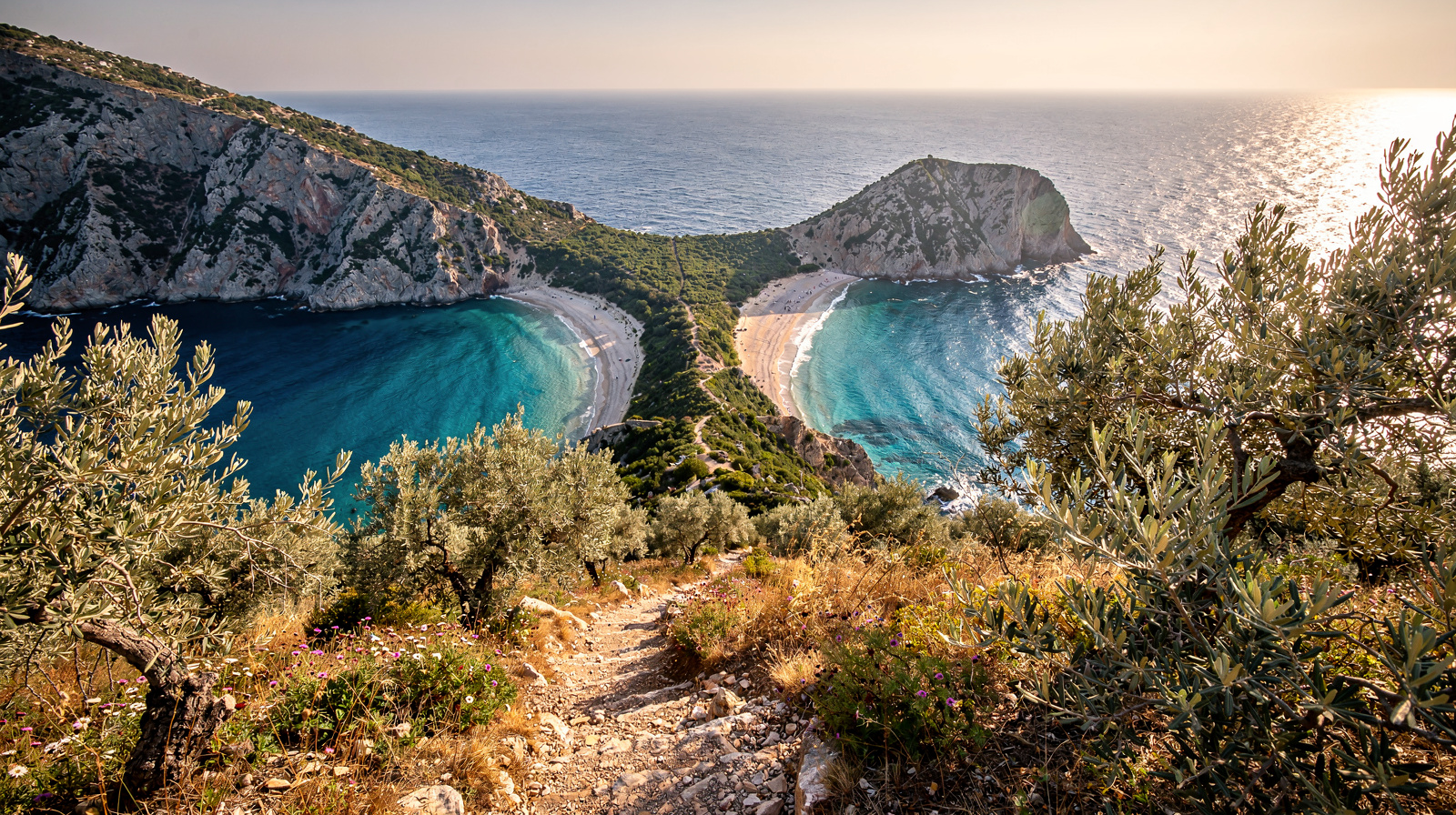
Corfu’s west coast is the dramatic one, and its poster image is Porto Timoni: twin crescent beaches back to back on a narrow isthmus below Afionas village, reached by a steep twenty-minute scramble that September temperatures finally make civilised. Further south, Paleokastritsa gathers six interlocking coves under cliffs and cypress, with some of the clearest water in the Ionian — this beach shortlist sorts the coast honestly, Glyfada for sand and facilities, Myrtiotissa for wild swimming. Walkers get the better end of the September deal: the Corfu Trail runs 220 kilometres from Kavos to the northern cape through olive groves and cliff paths, and its day sections are at their best once the heat breaks. And the classic day at sea still departs Corfu port every morning: the cruise to Paxos, Antipaxos and the blue caves — nine hours, a swim in Antipaxos water the colour of swimming-pool advertising, and change from €50.
Pastitsada, bourdeto and a bottle of ginger beer
Corfiot cooking is Greek with a Venetian accent. Pastitsada — rooster or beef braised in a spiced tomato sauce over thick pasta — is the Sunday dish; sofrito is veal in white wine and garlic; bourdeto is scorpionfish in a paprika-hot broth that fishermen’s tavernas argue about endlessly. The Greek Gastronomy Guide’s taverna shortlist is the map to eat by, and two addresses deserve booking ahead: the Venetian Well, the Old Town’s most atmospheric table on a pocket-sized square around a 17th-century wellhead, and Klimataria in Benitses, where the Bellos family has cooked the definitive bourdeto since 1997. Wash something down with tsitsibira — the island’s own ginger beer, a British legacy still brewed locally — and take home kumquat liqueur, made from the little citrus the island adopted in the nineteenth century and now grows almost as a mascot.
An Old Town mansion or Durrell’s white house
September is when the island’s best rooms come back within reach. In town, Siora Vittoria puts nine rooms in a restored Venetian-era mansion with a walled garden, close enough to the Liston to hear the evening volta start. On the Durrell coast, the San Antonio Corfu Resort hangs adults-only rooms off the cliff above Kalami Bay, all of them facing the water. And the White House itself, mentioned above, books out its September weeks to people who plan ahead — which is rather the theme of this article. For a broader sweep of areas and beaches before committing, Greeka’s island overview covers the geography, and a five-day itinerary like this one shows how town, coast and boat day fit a working week.
On screen, before you arrive
Corfu at street level and from the water:
Corfu Town, Greece 4K Walking Tour
Living Walks
CORFU — We found paradise! | Best beaches & top things to do
TraveLike
Getting there and back
Corfu’s airport sits ten minutes from the Old Town, and in September it is still fully connected — direct flights from a dozen UK airports and most major European cities, on everything from Ryanair and Jet2 to British Airways. The catch is the calendar: the seasonal routes wind down from late September and largely stop by the end of October, after which the island reverts to Athens connections and its winter self. A hire car is worth it for the west coast and Old Perithia; town, the Durrell bays and the Paxos boat all work without one.
The window, then, is about six weeks wide: sea at its warmest to mid-October, direct flights until the clocks change, prices dropping from mid-September. The taverna shortlist, the Porto Timoni trail notes, the Paxos boat day, the Venetian mansion and the Durrells’ actual house are all gathered in our Corfu collection — save it, pick your September week, and be on the Liston with a kumquat liqueur when the evening walk begins.
Curated using Epic Itineraries. Log in to save this collection to your own plan.