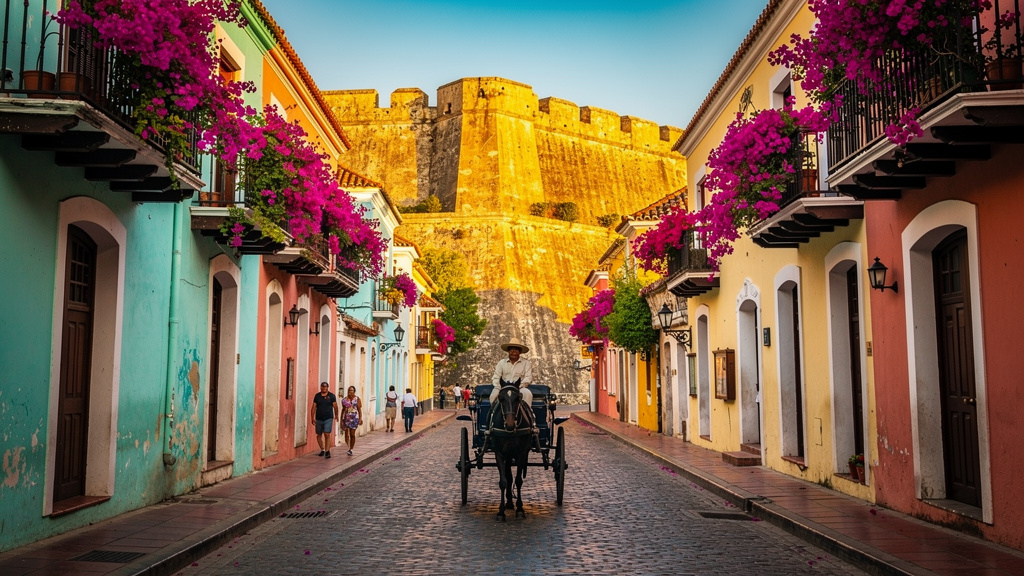
The walls are thirteen kilometres long. They were built in the late 16th century to keep out pirates — English ones, mostly — and they mostly worked. Four hundred years later, they still define the city: a ring of ochre stone punctuated by cannons, inside which sits one of the great preserved colonial quarters of the Americas, and just beyond which spills a neighbourhood, Getsemaní, that has rewritten itself over the last decade from no-go zone to one of the most vibrant urban spaces on the continent. Cartagena de Indias is not a museum. It is a working Caribbean city that happens to wear exceptional architecture.
This is also the city that Condé Nast Traveler, Lonely Planet and Skyscanner all named on their 2026 destination lists, and the case for going in April is almost entirely about the weather. The Caribbean dry season holds through March and tails off into May; April is the last reliable month of blue skies and sunset cocktails on the walls before the afternoon rains take over and room rates drop. Catch it now and the city is in its sweet spot: warm but not oppressive, crowded but not heaving, and — crucially — still slightly cheaper than it will be next year.
Inside the walls
The walled city is compact enough to walk end-to-end in twenty minutes, and you will lose hours inside it anyway. A long-term resident’s guide is the single most useful resource we have — opinionated, current, and honest about which plazas are worth lingering in and which are tourist funnels. Nomadic Matt’s practical overview pairs well with it for costs, safety and itinerary shapes.
The Centro neighbourhood, inside the walls, is the grand one: pastel colonial mansions with bougainvillea tumbling off their balconies, plazas named for the saints and the liberators, horse carriages at night. Plaza Santo Domingo anchors it, with its mustard-yellow church and Fernando Botero’s bronze sculpture of a rounded, reclining woman. Plaza Bolívar, two streets away, fills with dancers in the evenings — the open-air performances are free, the tipping expected.
The Castillo de San Felipe de Barajas is the defensive masterpiece outside the walls: a 17th-century fortress riddled with subterranean tunnels that visitors can still walk through, torch in hand. Condé Nast Traveler’s best-things-to-do list has the clearest contemporary overview of what is worth queueing for; National Geographic’s local voices piece is the one that sets the colonial story alongside its Afro-Caribbean one, which matters because Cartagena is equal parts Spanish and African and any guide that misses this misses the music.
For a two-day city break, this tight Caribbean-walled-city itinerary gets the fundamentals without rushing. This first-timer’s complete guide adds the practical safety notes that new arrivals usually want answered before they book.
Getsemaní in the evening
If the walled city is Cartagena’s grand living room, Getsemaní is where the neighbourhood actually lives. The barrio sits just outside the walls and, until fifteen years ago, had a reputation for gun violence that kept tourists firmly inside the old town. It has rewritten itself completely. Today it is street art, salsa bars, hostels, and the most interesting restaurants in the city — and by evening the whole place seems to empty onto Plaza de la Trinidad, where fresh-juice stalls, impromptu dance circles and backpacker kitchens share the same cobbles.
A walking guide to the neighbourhood’s best streets is the right starting point — Calle San Juan is the open-air art gallery, Calle de la Sierpe is the one with the umbrellas strung between the buildings. This local-run overview has the quieter recommendations: the church of Santísima Trinidad, the small gallery-café scene, the salsa clubs like Donde Fidel and Café Havana that have been running for decades.
Come at dusk. Stay late. Walk back slowly.
Where the food is
Colombian cooking took its time to reach the international stage, and Cartagena is the city where it has arrived loudest. The Caribbean coast has its own cuisine — arroz con coco, cazuela de mariscos, ceviches that lean sharper and more herbal than Peruvian ones, bluefin tuna and snapper landed hours before they are served.
Celele is the pilgrimage: a research-led restaurant that has mapped the ingredients and techniques of the Colombian Caribbean and built a tasting menu around them, currently listed among Latin America’s 50 Best. Book a month ahead. Less formal but no less loved, Demente in Getsemaní serves tapas in a roofless colonial ruin. La Cevichería, in the walled city, became a pilgrimage of its own after Anthony Bourdain ate there; it is still excellent if you go early. This list of 23 Cartagena restaurants is the broadest single roundup, and this walled-city-and-Getsemaní split is useful for building an evening plan around where you are already standing.
For a shorter shortlist — the five places we would prioritise on a first visit — this Getsemaní picks piece is tightly edited and still current.
Street food matters here too. The fruit carts around Plaza de Bolívar cut mango, papaya and pineapple to order with salt and lime. Arepas de huevo — deep-fried corn cakes with an egg cooked inside — are best from the stalls near the central market. Aguapanela, a sugarcane infusion served hot or cold, is the local answer to most weather.
The Rosario Islands
Cartagena’s own beaches are not its strongest asset, and everybody knows it. The trick, which the city itself will explain within ten minutes of your arrival, is to get on a boat and go to the Rosario Islands — a scatter of 27 coral cays a short speedboat ride south, within a national marine park.
Tours range from relaxed catamarans to full-throttle party boats, and the experience you end up with depends entirely on which you pick. This comparison of the main day-trip options is the honest breakdown, including which operators to avoid. This practical day-trip guide includes the quieter island alternatives for travellers who have no interest in dancing to reggaeton at 11am.
Catamaran tours tend to include snorkelling gear, lunch and stops at two or three islands. Beach-club day passes at places like Bora Bora or Blue Apple give you a fixed base for the day. Private mangrove tours, out of the smaller town of Barú, add a cultural layer that the party boats skip — the Afro-Colombian fishing communities whose families have lived on these islands for centuries.
A roof inside the walls
Inside the walls, expect to pay for the privilege. Casa San Agustín is the 17th-century flagship of the walled-city boutique scene — restored palace, whitewashed colonnades, plunge pools where a library used to be. An honest boutique roundup from the same long-term resident covers the rest of the top tier with the compromises spelled out.
If budget matters, Getsemaní is cheaper, livelier and still extremely safe. This mid-range boutique list has transparent pricing and picks the properties that give you a pool and a rooftop without the full walled-city markup.
April is the last clean month of the dry season. By late May the afternoon storms return, the cruise ships ease off, and the city goes briefly back to being mostly its own again. Go while the sky is still clear. Walk the walls at sunset. Eat in Getsemaní. Take the boat.
Ready to plan your Cartagena escape? We’ve curated the best restaurants, boat trips and walled-city stays in our Cartagena collection — save it to your itinerary and start exploring.