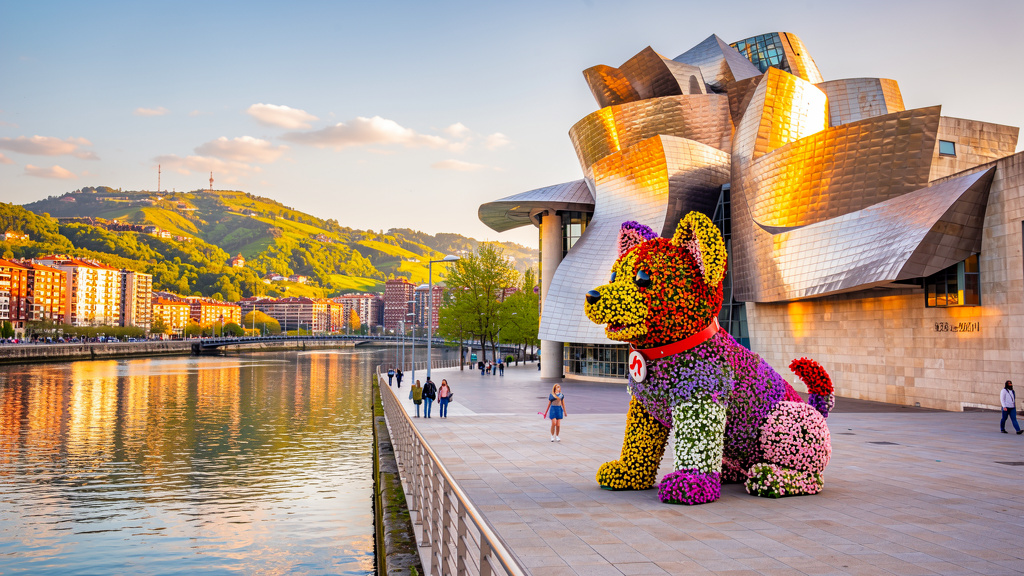
The old Bilbao was a port town the rest of Spain sent its iron through. Then, in 1997, Frank Gehry dropped a titanium ship in the middle of the river and the city has not stopped reinventing itself since. The new Bilbao is what happens when a post-industrial place decides to do hospitality, architecture and food better than almost any capital in Europe — and still not charge Paris prices for the privilege.
Spring is when it is at its best. The city sits at 43° north, on the Atlantic rather than the Mediterranean, which means April and May arrive with long daylight, temperatures in the high teens, light green softening the surrounding Basque hills, and none of the heat-dome weeks that flatten Seville and Córdoba by July. Hotel rates are 40–50% below their summer peak. The Ribera market’s spring produce — white asparagus, tomatoes from Getaria, elvers — is at its most interesting of the year. And the pintxos bars of Plaza Nueva can actually be walked into rather than queued for.
Two days for first-timers, three for the rest
Bilbao’s centre is genuinely walkable end-to-end; the Casco Viejo (Old Town) and the new city across the Ría de Bilbao are fifteen minutes apart on foot. For the cleanest two-day plan, this itinerary from The World Was Here First does the work of three different guidebooks — Guggenheim, Casco Viejo, Artxanda funicular, Ribera market, and a proper pintxos crawl fitted into a walkable loop. A Bilbao local’s own two-day version is the essential cross-reference; it calls out the pintxos bars locals actually prefer (not always the famous ones) and flags the timing tricks that save a wait. For a third-day cross-check, Bilbao Turismo’s official three-day plan is the belt to the blogs’ braces.
The big fixed points are fixed for a reason. The Guggenheim is one of the few world-famous museums where you can actually breathe — arrive at 10am or after 4pm to catch the Serra gallery empty, and budget at least a slow hour on the river promenade outside. Puppy (Jeff Koons, 40,000 flowering plants) and Maman (Louise Bourgeois, giant steel spider) are free and do not need a ticket. The Casco Viejo’s Siete Calles — the seven medieval streets laid out in the 14th century — are where Bilbao’s Old Town guide sends you for independent shops, traditional taverns and the pintxos crawls that lead you back to Plaza Nueva by nightfall.
Pintxos, properly
Bilbao’s food identity is pintxos: miniature plates eaten standing at a bar, traded for a few euros, washed down with txakoli poured from height into a wide glass. Lonely Planet’s Basque Country foodie guide explains the underlying grammar — cold pintxos waiting on the counter, hot ones ordered from the list behind the bar, two or three at one place then you move on. Do not sit down, do not try to make a meal of it at a single stop, and do not under-tip the cured iberico.
For actual addresses, Happy Jetlagger’s pintxos guide is the most practical single read — opening hours, what to order at each bar, how to string a crawl together. Appetites Abroad’s Bilbao food guide does the same job with richer background on the Basque dishes themselves: the gilda (the original pintxo, a skewer of anchovy, green olive and guindilla pepper), bacalao al pil-pil (salt cod emulsified in its own gelatin), txangurro (spider crab), and the Idiazabal soup at Gure Toki which is the best non-negotiable order in the Casco Viejo. Pintxos and Beyond from The Slow Cyclist is the one to follow if you want to mix pintxos nights with a serious sit-down Basque dinner; Mondomulia’s Plaza Nueva crawl is the classic primer that most of the city’s food writers quietly still consult.
Two practical notes. The peak pintxos windows are 1–3pm and 6–8pm; arrive outside those and you will be served, but the counters are at their most interesting when the city is eating with you. And the Ribera Market — the largest covered market in Europe, Guinness-certified — is a better place to spend a rainy morning than any museum the Casco Viejo can offer.
Where to stay: three distinct feels
Bilbao has the useful feature of three genuinely different neighbourhoods to base yourself in. Go Ask A Local’s neighbourhood guide is the honest breakdown — Casco Viejo for the narrow-street character and the closest bars, Abando for walking distance to the Guggenheim without the night noise, and Indautxu for the cleaner modern feel and the sense of eating where locals eat.
Mr & Mrs Smith’s Bilbao selection is the most carefully vetted boutique list — Hotel Tayko in a converted warehouse with a Berasategui-run restaurant, and the quieter design-led stays on the riverfront. Secret Places is stronger on the smaller pensions and the rural boutique options within a short drive of the city. For the design-led shortlist, The Mediterranean Insider’s five best surfaces Palacio Arriluce, a 1912 family mansion turned spa hotel on the Getxo coast — ten minutes from the centre on the metro and a good answer for anyone wanting a beach-adjacent finale.
Out of the city for a day
Bilbao is a one-hour radius from most of what makes the Basque Country special. This sober eight-trip assessment is the most useful starting point — it flags what is genuinely worth the journey (San Juan de Gaztelugatxe, Rioja Alavesa, a slow drive up the coast) and what is not.
Gaztelugatxe is the one most visitors put at the top of the list: a hermitage perched on a rocky islet linked to land by a zig-zag 241-step stone stair, cameo’d as Dragonstone in Game of Thrones. This self-guided walkthrough is the cleanest primer on parking, timing and the mandatory advance booking system that was introduced after the television crowds. Do it mid-morning or late afternoon, not at midday.
The other classic is Rioja Alavesa — the Basque slice of La Rioja, an hour south of Bilbao, with Laguardia’s walled hilltop villages and cellars designed by architects who also built European airports. This sherry-and-Rioja context piece is a useful scan of what a structured wine day can look like, though the serious oenophiles tend to arrange visits directly with three or four cellars (Marqués de Riscal, Ysios, Bodegas Baigorri) and hire a driver.
Press play
Two videos that capture the city at the right tempo:
A Beginner's Guide to Bilbao
Wild About Travel
An Amazing 48-Hour Pintxo Tour of San Sebastián and Bilbao
The Best Ever Food Review Show
From Bilbao
The rule of thumb from most recent visitors: two nights in Bilbao and two in San Sebastián is the perfect Basque introduction; three in Bilbao alone, with day trips, is the better choice if you are travelling as a two rather than a group.
The city is in a shoulder window that narrows fast. By June the Atlantic summer crowd starts to arrive, the Rioja turns golden rather than green, and hotel rates climb back towards their July ceiling. April and early May — that is the moment.
Six weeks until the shoulder window closes. Two-day itineraries, Michelin-touched pintxos bars, boutique stays and Rioja day-trip logistics — all gathered in our Bilbao collection. Save it before June rates land and the Serra gallery fills up.
Curated using Epic Itineraries. Log in to save this collection to your own plan.