Four hours west of Lisbon, somewhere above the mid-Atlantic ridge, the clouds part and a chain of volcanic islands comes into view — green, improbable, very clearly not part of anywhere else. The Azores don’t belong to Europe in the way the rest of Portugal does. They don’t belong to the Americas either, despite being closer to Newfoundland than to the mainland. They sit in their own weather system, on their own clock, and in spring they host one of the most remarkable wildlife spectacles on the planet.
April and May are the moment the archipelago becomes unmissable. Fin, blue and sei whales pass through on their annual migration, joining the resident sperm whales and dolphin pods that already give the islands the highest whale-sighting rate in the world. It also happens to be the quietest shoulder of the travel year — before the summer crowds, after the winter storms, with hydrangeas just beginning to streak the roadside banks in blue.
Why the islands are different
The Azores are a nine-island archipelago, Portuguese but culturally their own, formed by the volcanoes that built the mid-Atlantic ridge. National Geographic’s first-timer’s guide is the clearest explainer of which island does what: São Miguel is the populous one that most visitors fly into, Pico is for walkers and wine drinkers, Terceira and Faial have the prettiest towns, and the smaller islands — Flores, Corvo, Santa Maria — reward the patient.
Most trips in a week-long window collapse into São Miguel plus a short hop to Pico or Terceira. Into the Azores’ overview and Lonely Planet’s archipelago primer are useful for working out which island pairing suits your instinct: nature and spa (São Miguel on its own), drama and hiking (São Miguel plus Pico), or towns and ferries (Faial plus Pico plus São Jorge, the so-called triangle islands).
São Miguel in four or five days
The green island is the one you can reasonably see in four or five days if you drive. This five-day itinerary from a local is the single best planning resource we have found — it includes a map, driving times and a summary table that cuts through the confusion most first-timers feel when staring at the island on Google Maps. Geeky Explorer’s four-day version is tighter and good if your flights are inflexible.
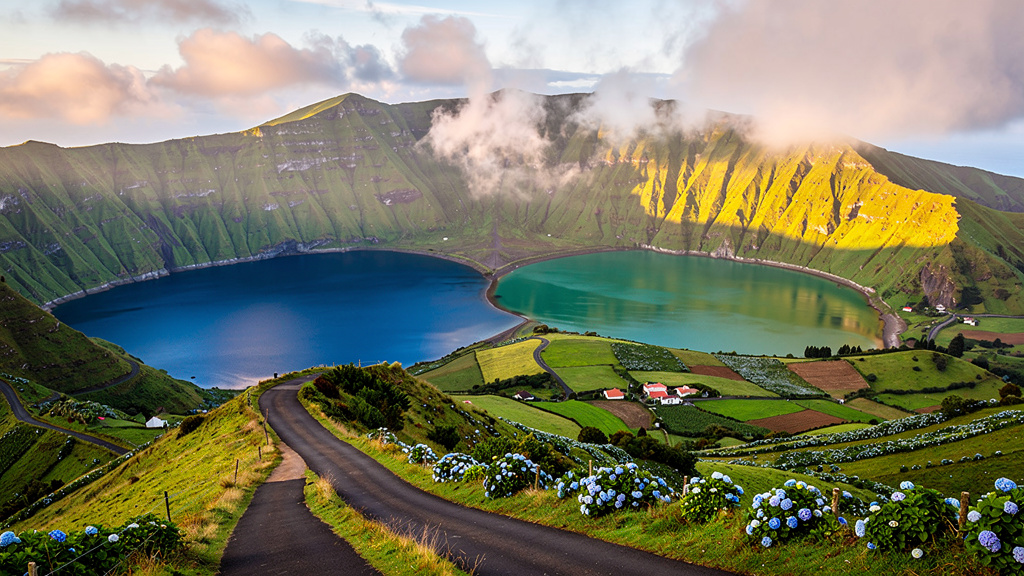
What you are mapping around are three set-piece landscapes. Sete Cidades is the twin-lake caldera on the west side of the island, one lake blue and one green. The Miradouro da Boca do Inferno is where the postcard shots are taken; the best time is early morning, before the cloud rolls in. Lagoa do Fogo, roughly in the middle of the island, is a protected crater with no buildings on its shoreline — you hike in, swim if you are brave, and hike out. Salt in Our Hair’s São Miguel overview has the clearest photographs of what to expect. Furnas, to the east, is where the island gets strange: the caldeiras steam out of the earth, the streams run sulphurous, and lunch is being cooked underground in metal pots.
Dangerous Business’s five-day plan and Random Trip’s map-based guide both stitch these three together into a looping road trip, with half-days left over for Ponta Delgada’s black-and-white tiled squares, the Gorreana tea plantation (the oldest in Europe), and the east-coast miradouros around Nordeste that almost nobody drives out to.
The whale-watching window
April through June is when the migration peaks. Fin whales — the second-largest animal that has ever lived — are the ones most people come to see, and they move through in pods that sometimes number in the dozens. Blue and sei whales join them. Sperm whales are resident year-round, as are common, bottlenose and Atlantic spotted dolphins. Futurismo, one of the archipelago’s most established operators, breaks down the month-by-month sighting rates and their charts are the honest ones: they include days with no sightings, which are rarer than you might fear but not impossible. Overall success sits above 98%.
Tours go out from Ponta Delgada, Vila Franca do Campo and Ribeira Grande on São Miguel, and from Lajes on Pico — the latter still run partly by descendants of the old whaling families, now turned conservationists. Velvet Escape’s account is a good sense-check of what the half-day feels like, including the seasickness that catches out most first-timers. Take the tablet.
The lunch that cooks itself
Every travel piece written about the Azores eventually talks about cozido das furnas, and with good reason: there is nowhere else in the world where this meal exists. A definitive piece on how it works is worth reading before you go, but the short version is this: meat, sausage, cabbage, potatoes and morcela are layered into a metal pot, the pot is buried in a volcanic vent in Furnas Lake, and after five or six hours the earth hands it back, slow-cooked and faintly sulphurous.
The ritual of seeing the pots lifted out around 1pm is part of the experience; the eating happens afterwards in village restaurants. An atmospheric piece of food writing on the same dish captures the sense of it better than most. Terra Nostra, Tony’s and Caldeiras e Vulcões are the restaurants most often recommended; Azores Choice’s Furnas-area eating guide is where to go for the quieter local picks. Book ahead. Every day.
If you add Pico
Pico is the second-largest island and the one with the mountain — 2,351 metres of stratovolcano rising straight out of the Atlantic, the highest point in all of Portugal. It is also the island where the vineyards are. UNESCO-listed stone walls called currais shelter hardy vines from the wind, producing volcanic whites that most visitors have never heard of and never forget.
Hunting for Bliss’s hiking guide runs through the five walks worth doing, including the mountain summit itself, which is genuinely demanding and should only be attempted with a guide or at least an accurate forecast. The official Azores trails database has every route in GPX form along with honest difficulty grades. Easier days can be spent on the Vinhas da Criação Velha trail through the vineyards, or on the south coast lava fields known locally as the Mistérios — the “mysteries” — where 18th-century eruptions left black rivers of rock running into the sea.
Where to wake up
Accommodation on the Azores has caught up with the landscape in the last five years. JO&SO’s hand-picked boutique list covers the best of São Miguel — Herdade do Ananás on a working pineapple plantation, The Farm in a restored 19th-century townhouse in the capital, and Santa Barbara Eco-Beach Resort for surf-lesson mornings on the north coast. For rural guest houses and smaller country stays outside the main towns, Secret Places’ collection is the better starting point.
The window is narrow
The window is narrow. The whales move through, the hydrangeas flower, and by July the island is fuller and the prices climb. Right now, in the shoulder weeks of April and May, the Azores are doing the quiet, astonishing thing they have been doing for millions of years — only most of the world still has not noticed.
Ready to plan your Azores spring? We’ve curated guides, whale-watching operators and boutique stays in our Azores collection — save it to your itinerary and start exploring.