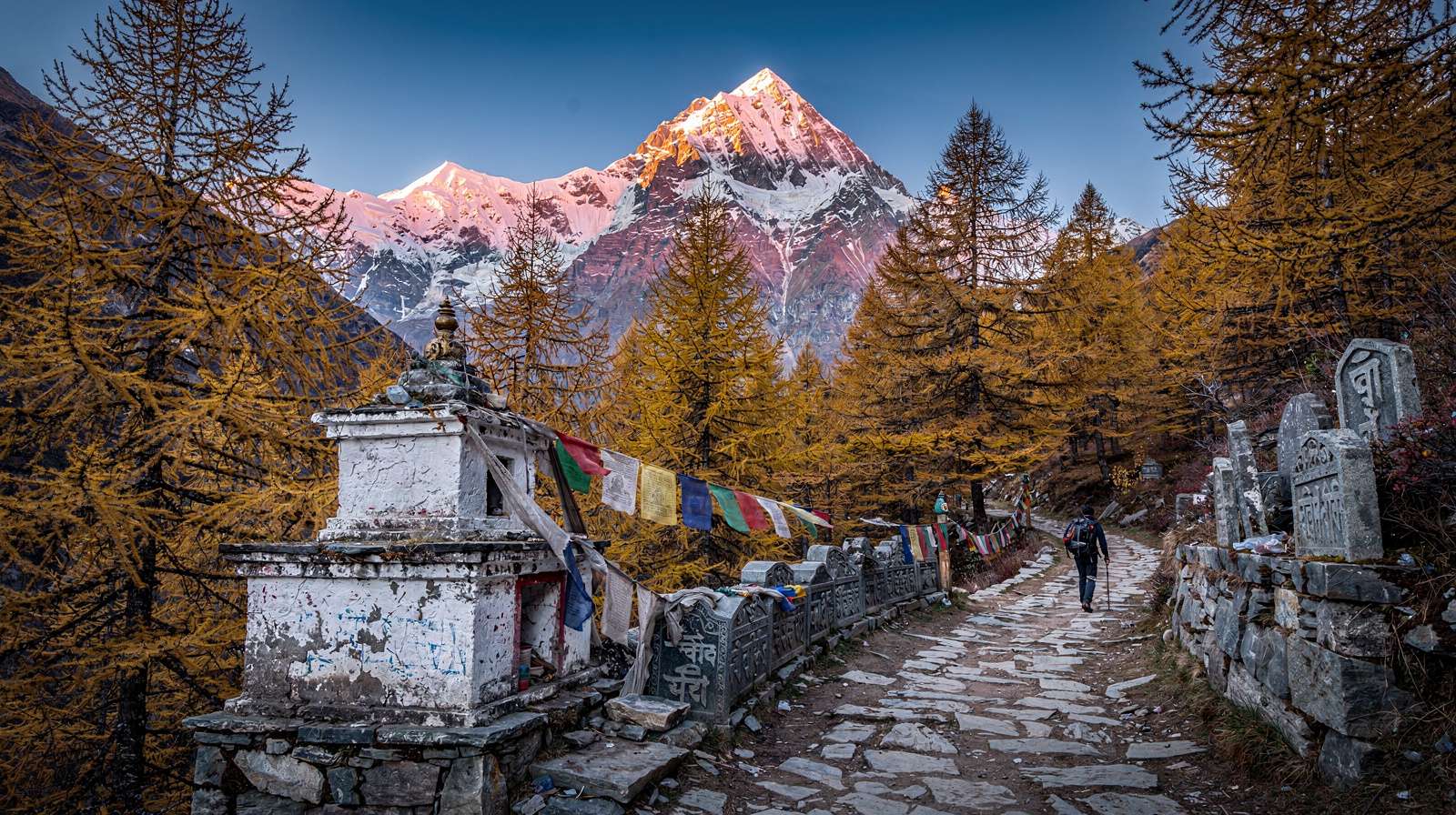
On Sunday 8 November every dog in Nepal — the strays included — gets a marigold garland, a red tika on the forehead and a plate of meat. That is Kukur Tihar, the second day of the festival of lights, and in 2026 the calendar has folded it onto Laxmi Puja, so the same evening every doorstep in the Kathmandu Valley is lined with oil lamps. It lands at the tail of the best six weeks in the Nepali year. The monsoon withdraws around 2 October, the dust is washed out of the air, visibility runs to a hundred kilometres, and Kathmandu sits at 20–25°C by day. Everyone who treks knows this, which is why Everest Base Camp is a queue in October.
The New York Times put “Nepal’s Other Mountains” at No. 11 on its 52 Places to Go in 2026, and Lonely Planet’s revised trekking guide makes the same argument from a different direction: Manaslu, Kanchenjunga, Dolpo and Rara for anyone who wants the Himalaya without the Lukla flight. The US advisory came back down to Level 2 in March after the 2025 unrest, and then, on 26 August, a glacier fell off Langtang Lirung. This is a guide to the mountains that are open, and honest about the one that is not.
Manaslu, the circuit that is still a circuit
Most of the classic Nepali routes have had a road pushed up them; the Annapurna Circuit’s core can now be walked in nine days because the rest is tarmac. Manaslu is the exception — 177 km in about fourteen days, in a genuine loop round the world’s eighth-highest mountain, with the 5,106-metre Larke La as the hinge. The pass day is seventeen kilometres, 700 metres up and 1,570 down, eight to ten hours. Before it comes Samagaun at 3,530 metres, the acclimatisation stop, and Samdo, a village on the Tibetan border whose people, language and monastery are functionally Tibetan.
The restricted-area permit for Manaslu is USD 100 for the first seven days and USD 15 a day after that in the autumn season, plus NPR 3,000 each for the Manaslu and Annapurna conservation areas; the Nepal Tourism Board’s fee table is the only version worth trusting, because half the operator pages are out of date. A second flash flood on 6 September took the suspension bridge at Namrung; Outshine Adventure’s reopening update has the temporary wooden bridge in place and the route running. Mid-October to early November is the window.
Mustang at fifty dollars a day
For years Upper Mustang charged USD 500 for a ten-day permit even if you stayed five. That rule is gone: since 27 July 2026 the permit is USD 50 per person per day for the days you actually spend inside the zone, and it applies identically to trekkers, jeep passengers, motorbikes and anyone arriving by helicopter. A five-day jeep run from Jomsom to Lo Manthang now costs USD 250 in permit; a fortnight on foot costs what it always did.
Mustang sits in the rain shadow of the Annapurnas, which makes it the one region in Nepal that also works in the monsoon and turns it, in late October, into a cold, wind-scoured desert of ochre cliffs pocked with cave dwellings. Lo Manthang is a walled town that was a royal capital until 2008. The walk in from Jomsom takes ten to fourteen days. If money is no object, Shinta Mani Mustang, Bill Bensley’s all-inclusive above Jomsom with private hot tubs and heated floors, is the only genuine luxury property on any of these routes; expect a five-night minimum and a four-figure nightly rate for two.
The one you cannot book
Langtang is the valley closest to Kathmandu, a seven-to-ten-day trek to Kyanjin Gompa at 3,830 metres with day climbs to 4,773 and 5,050, Tamang villages, and the cheapest permits of any headline route at under USD 50 all in. In the 2015 earthquake a landslide from Langtang Lirung erased Langtang village and most of the people in it. The teahouses from Lama Hotel to Kyanjin were rebuilt, family by family, into one of the best community-run trails in the country.
On 26 August 2026 part of a glacier on the same mountain collapsed. The floods went down the Lhende Khola into the Trishuli, destroyed the Gyirong border crossing with Tibet and broke the 42-kilometre Betrawati–Rasuwagadhi road at several points. Nationally the toll runs to hundreds dead and thousands missing, most of them in the southern plains, and every figure is still provisional. The valley itself is intact, but the only road in is not, and officials talk in months. The Longest Way Home’s flood page and Travel Himalaya Nepal’s region-by-region status are being updated as the picture changes. Do not book Langtang, Gosaikunda or the Tamang Heritage Trail for this autumn on an operator’s say-so, and if the road reopens, the rebuilt lodges will need the business more than anyone.
The same floods took a seventy-metre bite out of the Prithvi Highway at Krishnabhir. Fly Kathmandu to Pokhara; it is twenty-five minutes.
Two more, at opposite ends of the budget
Kanchenjunga, in the far east, is the emptiest of the big trails: three to four weeks to Pangpema at 5,143 metres under the world’s third-highest mountain, with lodges that shade into homestays. The restricted-area permit is USD 20 a week, so a month costs about USD 95 — less than two days in Mustang. Pikey Peak is the opposite: five to seven days in the Solu hills, driven in from Kathmandu with no Lukla flight, to a 4,065-metre summit Edmund Hillary is widely reported to have called his favourite view of Everest; Outfitter Nepal’s itinerary shows how little of the week is above 3,500 metres.
Dashain, Tihar and the week the counters close
Dashain runs 11 to 25 October, with tika day on Wednesday the 21st: elders press rice, yoghurt and vermilion onto foreheads, bamboo swings go up at crossroads, kites fill the valley sky, and several million people leave Kathmandu for their villages. The catch for trekkers is that the permit counters close too, roughly 19 to 23 October — collect TIMS, conservation and restricted-area permits before the 19th or plan to start after the 24th. The week straight after Dashain is the busiest of the year on the trails; the sweet spot is the end of October into November, when the counters reopen, the skies are at their clearest and Tihar arrives on 7–11 November: crows, then dogs and lamps on the 8th, cows, the Newar new year, and Bhai Tika on the 11th, when sisters mark their brothers with a seven-strand tika in five colours.
Kathmandu Valley, while you acclimatise
Three royal cities, three different recoveries. Bhaktapur ran its own reconstruction after 2015 rather than waiting for the state, and the squares are whole again; foreigners pay USD 15. Patan’s Durbar Square is about 95% restored, largely by the Kathmandu Valley Preservation Trust and the metalworkers and woodcarvers who still live in the lanes behind it. Boudhanath is for dusk, from five, when the butter lamps go on round the stupa and the rooftop cafés fill; the entry fee is NPR 400 and the tour buses have gone.
Eat in Patan. Raithaane was opened in a courtyard off the square by two Nepalis and a Frenchman to prove the country’s food is not momos and dal bhat: foxtail millet from the west, roasted barley from the Sherpa north, and yangben, a wild lichen the Limbu of the east have always eaten. In Kathmandu, Bhojan Griha serves a long organic set menu with folk music in a 150-year-old priest’s palace for around NPR 4,500, and Krishnarpan at Dwarika’s stages Nepali regional cooking as a six-to-twenty-two-course ritual on brass and earthenware; reserve.
A courtyard on Patan’s square, a salvaged palace in Kathmandu
Dwarika’s Hotel exists because of a cooking fire. In 1952 Dwarika Das Shrestha, jogging past a demolition, saw carpenters sawing the carvings off an old pillar to burn; he bought the pillar, then kept buying windows, doors and struts from every building that came down, and by 1964 had enough salvaged Newari woodwork to build a hotel around it. The Inn Patan is the quieter choice: ten rooms in a brick-and-timber house on Patan Durbar Square itself, restored by the conservation architect Rohit Ranjitkar, from USD 100 a night with breakfast and a home brewery in the courtyard. In Pokhara, Temple Tree is the garden-and-pool resort a few minutes from Phewa Lake, and the recovery base after a fortnight of dal bhat.
Two films that capture the place
A hundred miles of Manaslu, and the long walk to the walled city:
Hiking 100 Miles on NEPAL's Most Underrated Trek | MANASLU Circuit (part one)
Flora Gonning
A Journey to the Edge of Tibet – Upper Mustang Trek, Nepal Himalaya
Nicholas Eager
A few things worth knowing
Visas on arrival cost USD 30 for fifteen days, 50 for thirty and 125 for ninety, in clean dollar notes. Every foreigner trekking in a national park, conservation area or restricted zone needs a licensed guide through a registered agency — the rule has stood since April 2023 — but the two-person minimum for restricted-area permits was scrapped in March, so a solo traveller can now hold a Manaslu or Mustang permit in their own name. Follow Alice’s permit guide walks through the paperwork. There is no direct flight from Amsterdam: Qatar via Doha, Turkish via Istanbul and Emirates via Dubai are the usual routes, at roughly €900–1,050 return in October. Insurance must name trekking to 6,000 metres and helicopter evacuation in writing; a rescue costs USD 3,000–20,000, and Nepal has a documented problem with flights that were never medically necessary, so say no to one you do not need. Carry cash for the whole trek; teahouses charge for hot water, charging and wifi. Dutch readers should check the reisadvies at nederlandwereldwijd.nl rather than the American level.
Five weeks until the permit counters shut for Dashain, seven until they reopen onto the clearest skies of the year. The Manaslu reopening notes, the new Mustang permit arithmetic, the Patan courtyard hotel, the lichen restaurant, the festival calendar and the flood tracker are in our Nepal collection — save it, book the guide before 19 October, and be somewhere above 3,000 metres on the night the lamps go on.
This guide was curated using Epic Itineraries — save links from anywhere on the web, organise them into collections, and turn research into itineraries.