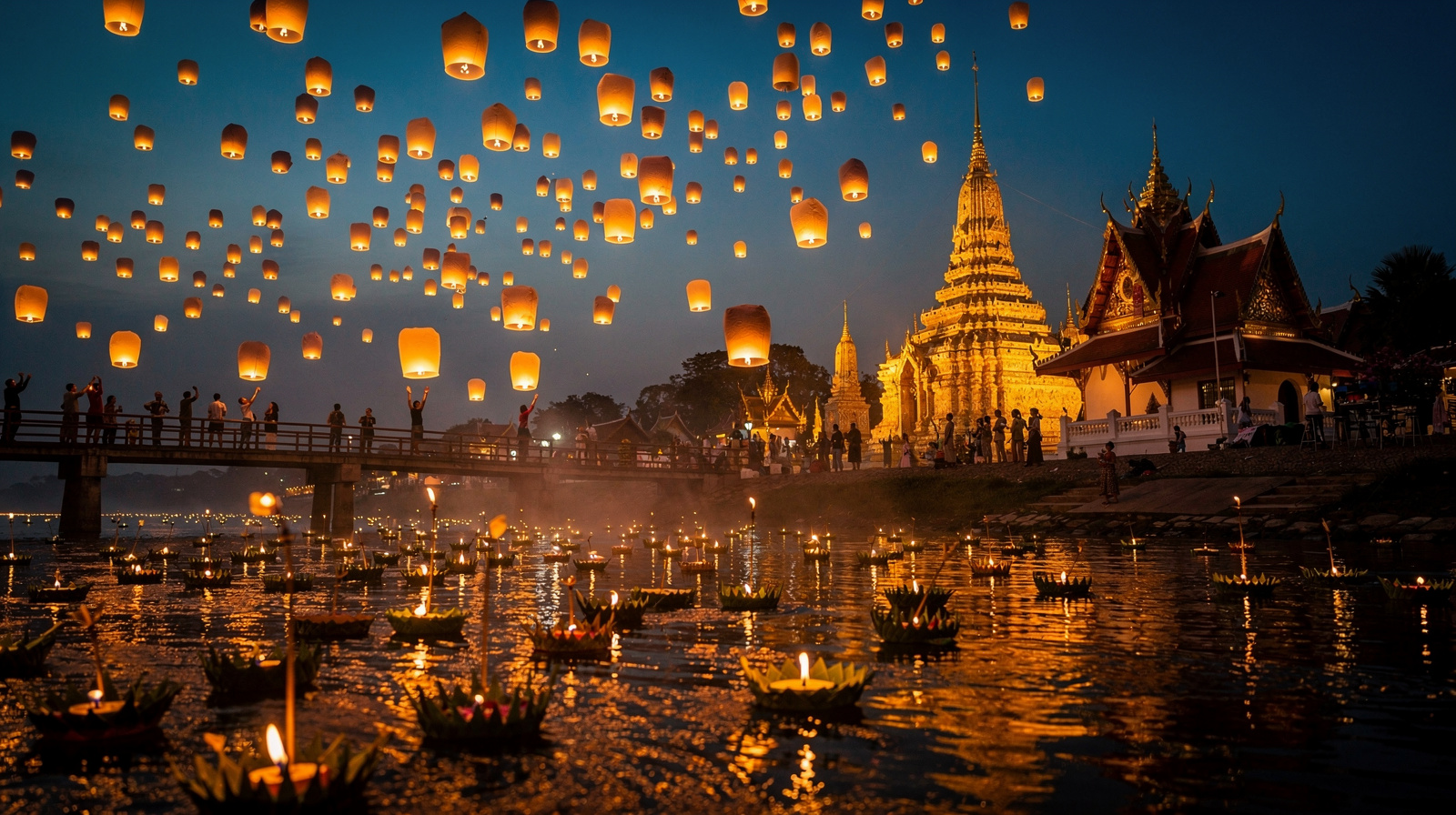
At 21:53 on Tuesday 24 November the moon over Chiang Mai will be full, and a small supermoon at that. It marks the fifteenth night of the twelfth month in the Thai lunar calendar, and the whole north of the country has been counting down to it. Two nights before, clay lamps go on along the moat and around the four old city gates. On the night itself people crouch on the banks of the Ping River and push off krathongs, little rafts of banana leaf, marigolds, a candle and three sticks of incense, to thank the water and send the year’s bad luck downstream. Somewhere out in the hills, thousands of paper lanterns go up at once.
That is Loy Krathong, which the whole country keeps, folded into Yi Peng, the Lanna festival of the second full moon that belongs to Chiang Mai. It also marks the start of the northern cool season. November averages a high of 31°C, a low of 20°C and about three days of rain, after an October that gets three times as much. The smoke season is months away. The province hasn’t published its 2026 programme yet (last year it came out on 3 October), so treat 24–25 November as the expected dates and check before you book a flight. The festival itself is not in doubt, but the way people see it has changed.
The lanterns you have heard about, and the rules nobody mentions
The photograph everyone has in mind, a sky filled with lanterns above a crowd in white, comes from a ticketed event, and it isn’t in the city. The CAD Khomloy release runs on 24 and 25 November in Mae On district, about 40 kilometres out, with coach transfers from town. The official ticket page lists six tiers from ฿4,900 to ฿15,900, each with two lanterns, a krathong, dinner and the ride, and on 30 September every one of them showed as sold out. Midnight Blue Elephant’s festival guide is the most level-headed account of whether the ticket is worth it, and of what the cheaper tier actually gets you.
The other thing to know is that you can’t simply buy a lantern and let it go. Last October Time Out reported the province grounding lanterns across six surveillance zones, including a 15-kilometre ring round the airport. The old city sits well inside that ring, releases were limited to approved events, and the penalties quoted ran to heavy fines and even prison. Airlines retime or cancel well over a hundred flights on the festival nights, and in 2025 the last departure was at seven in the evening. Don’t plan to fly in or out on 24 or 25 November, and leave your lantern to the people with a permit.
The free city, which is better than it sounds
None of this spoils the festival in town, which costs nothing and is the part the city makes for itself. If 2026 follows last year’s pattern (Chiang Mai CityLife published the 2025 Lanna Light programme day by day), the lamps go on around the moat, the Three Kings Monument and the gates about two nights before the full moon. A procession of several hundred dancers sets off from Tha Phae Gate, and the municipality’s Grand Yi Peng Parade, floats, royal-trophy krathongs and all, follows on the night after the full moon. On the full-moon night itself the Ping River is the place to be. Nawarat Bridge is the most crowded spot on the bank, and the teak courtyard of Wat Phan Tao, next door to Wat Chedi Luang, is the most beautiful when it’s lit.
That week also has a Sunday. The Sunday Walking Street closes Ratchadamnoen Road from Tha Phae Gate to Wat Phra Singh from about four in the afternoon. At six o’clock the whole street stops for the national anthem, and the best northern food is in the temple courtyards just off the road rather than on it. Bring cash, and expect it to be busier than usual on 22 November.
Temples, by day
Go and see the temples in daylight, before the evenings take over. Wat Phra Singh was founded in 1345. Its Phra Singh Buddha sits in the small, gilded Wihan Lai Kham, which is quieter than the main hall and finer. Wat Chedi Luang is the other one you must see: the chedi stood 82 metres tall until an earthquake in 1545 brought the top down, and the Emerald Buddha now in Bangkok once sat in its eastern niche. Both charge foreigners a small fee.
Wat Phra That Doi Suthep, up on the mountain, is 309 naga-lined steps above the car park, or a funicular ride if you’d rather. Driving up to the temple on the main road costs nothing, but since last October the national park around it has charged foreigners ฿100 at its trails and waterfalls, including the monk’s trail up from Wat Pha Lat.
Khao soi, and what the Michelin inspectors actually found
Chiang Mai has no Michelin-starred restaurant, whatever you may read. What it does have is eighteen Bib Gourmands, the guide’s mark for very good food at fair prices, and that suits the city better. The bowl to start with is at Khao Soi Mae Sai: coconut curry broth, soft egg noodles with a crisp tangle on top, pickled mustard greens and shallots on the side. A few doors along the same stretch of Ratchaphruek Road, Huen Muan Jai serves the rest of the northern repertoire in a wooden Lanna house in a garden: sai oua sausage, nam prik ong, gaeng hang lay, sticky rice in baskets.
For a slower evening before the parade, Kiti Panit on Tha Phae Road has rebuilt Lanna cooking inside a mansion from the 1880s that once belonged to the owners’ great-great-grandparents. It’s a two-minute walk from the gate.
Old city or the river
Where you stay decides how the festival nights go, so stay somewhere you can walk from. Tamarind Village, just off Ratchadamnoen Road, has 41 rooms set round shaded courtyards in the middle of the old city. That puts you in the Sunday market and the parade route without needing a car. Rachamankha sits beside Wat Phra Singh and is the city’s most considered boutique hotel, a quiet design-led retreat inside the walls.
On the east bank, 137 Pillars House is built round a teak house from the timber-trade era and is the smartest address within walking distance of the river. If you’d rather watch the krathongs float past than fight for a place on the bridge, Raya Heritage has 38 suites right on the Ping in Mae Rim, twenty minutes north, with a shuttle into town. Whichever you choose, book now; festival week is the most expensive week of the Chiang Mai year.
Beyond the moat
Doi Inthanon, Thailand’s highest point at 2,565 metres, is about 70 kilometres south-west. The park’s Kew Mae Pan trail is closed through the rains and reopens on 1 November, just in time for the cool season. Chiang Rai makes for a long day, and the White Temple has doubled its fee for foreigners to ฿200 since January.
The one excursion to think hard about is the elephants. Plenty of camps call themselves sanctuaries, and the word guarantees nothing. World Animal Protection’s position is that riding, bathing and hand-feeding all harm the animals, and that only observation counts as elephant-friendly. ChangChill in Mae Wang, a former riding camp that WAP helped convert, is the model: four elephants, no riding, and you watch from a distance while they graze and wander down to the river on their own.
Press play
A full-moon night by the river, filmed last November without narration, and a quicker first-timer’s tour by a Dutch couple:
4K HDR | Thailand's Largest Lantern Festival — Loy Krathong & Yi Peng in Chiang Mai 2025
REAL THAILAND 4K
Top 10 Things to Do in Chiang Mai for First-Time Visitors (2026)
Laurens & Laura
Getting there and back
There are no direct flights from Europe to Chiang Mai. KLM, EVA Air and, since July, Thai Airways all fly direct from Amsterdam to Bangkok every day, and Bangkok to Chiang Mai is just over an hour by air. Etihad’s one-stop route via Abu Dhabi returns on 25 October, now daily. Plan around the entry rules, which changed a fortnight ago: since 15 September Dutch and other EU visitors get 30 days visa-free, down from 60, for tourism only. Every arrival also needs the free Thailand Digital Arrival Card, filled in within 72 hours of landing. Only use the official site; the lookalikes charge for it.
Eight weeks until the full moon. The ticket and parade pages, the lantern rules, the Bib Gourmand khao soi, the courtyard hotels on the parade route and an elephant camp you can visit with a clear conscience are all in our Chiang Mai collection. Save it, book a room you can walk home from, and be on the Ping when the first krathong goes out.
This guide was curated using Epic Itineraries — save links from anywhere on the web, organise them into collections, and turn research into itineraries.