The bear was Canadian, and she was a she. In 1914 a veterinary officer called Harry Colebourn bought an orphaned black bear cub on a station platform in White River, Ontario, named her Winnie after his home city of Winnipeg, and shipped her to England as a regimental mascot. When his brigade left for France in December that year she was left at London Zoo, where a decade later a writer called A.A. Milne started bringing his small son to see her. The boy renamed his teddy after her. Milne bought a farmhouse on the edge of Ashdown Forest in 1925, walked the heath with the illustrator E.H. Shepard, and on 14 October 1926 Methuen published Winnie-the-Pooh.
The centenary is a month away. The New York Times put “Winnie-the-Pooh’s England” at No. 22 on its 52 Places to Go in 2026, and East Sussex spent the summer celebrating: a ten-person puppet creature toured the district, Cotchford Farm opened its garden for two days in May, and a council put £450,000 behind the programme. The puppet made its last appearance on 12 September. What is left, as the bracken turns, is better than the party — the forest itself, at the one time of year it looks exactly like Shepard’s drawings.
Sixty-three or sixty-four
Start at the top. Gills Lap is a clump of Scots pines on the highest open ground of the forest, and in the books it is Galleons Lap, the Enchanted Place, where nobody has ever settled whether there are sixty-three or sixty-four trees and where Christopher Robin says goodbye to Pooh. Shepard drew these actual pines; a bronze plaque beneath them credits him and Milne with having “captured the magic of Ashdown Forest and gave it to the world”. From the car park a short circuit takes in the Heffalump Trap, a hollow with a lone pine growing in it, the North Pole of the Expotition, Roo’s Sandy Pit and Eeyore’s Gloomy Place. The Conservators’ own Pooh page has the free leaflet.
The centenary’s lasting gift is six new waymarked trails, each named after a forest species rather than a bear: a dormouse, a green tiger beetle, a silver-studded blue butterfly, a nightjar, a Dartford warbler and an adder. The one to walk is the Dormouse Dawdle, 3.2 miles from Gills Lap around Wren’s Warren valley — the Enchanted Place, the best heath views and the pits, in an hour and a half. Collect a stamp at the Information Barn for each trail you finish. The Adder Loop starts at the Forest Centre, which has the toilets and the café.
Sticks first, then the bridge
Poohsticks Bridge was built in 1907 as Posingford Bridge, a plain crossing for carts and horses in a wooded ghyll below Cotchford Farm. Christopher Robin himself renamed it at a ceremony in 1979. By 1999 a century of visitors had worn it out; it was dismantled and replaced, with Disney putting money in, and in 2021 the original timbers sold at auction for over £131,000 to two anonymous buyers who re-erected it in a garden nobody has named. You will be dropping your stick from a replica, which changes nothing.
Park at the Pooh car park on Chuck Hatch Lane (TN7 4EX) and walk downhill, twenty to thirty minutes, signposted all the way. There are no toilets at the car park or on the path, and the good sticks near the bridge went years ago, so pick yours up on the way down. Third Eye Traveller’s walk-through has the turnings and the rules: upstream side, drop rather than throw, first stick under the bridge wins.
Afterwards, Hartfield. Pooh Corner, in the shop the Milnes used, is a small museum, a shop and two tearooms — Piglets for children, the E.H. Shepard room for the original sketches on the walls. Walk-in only, Monday to Saturday from eleven. National Geographic’s centenary piece follows the same route from bridge to village and adds the odd detail that the original toys have lived at the New York Public Library since 1987, and that this summer a newly made Roo was delivered to complete the set; the original went missing in the 1930s.
The forest is mostly not forest
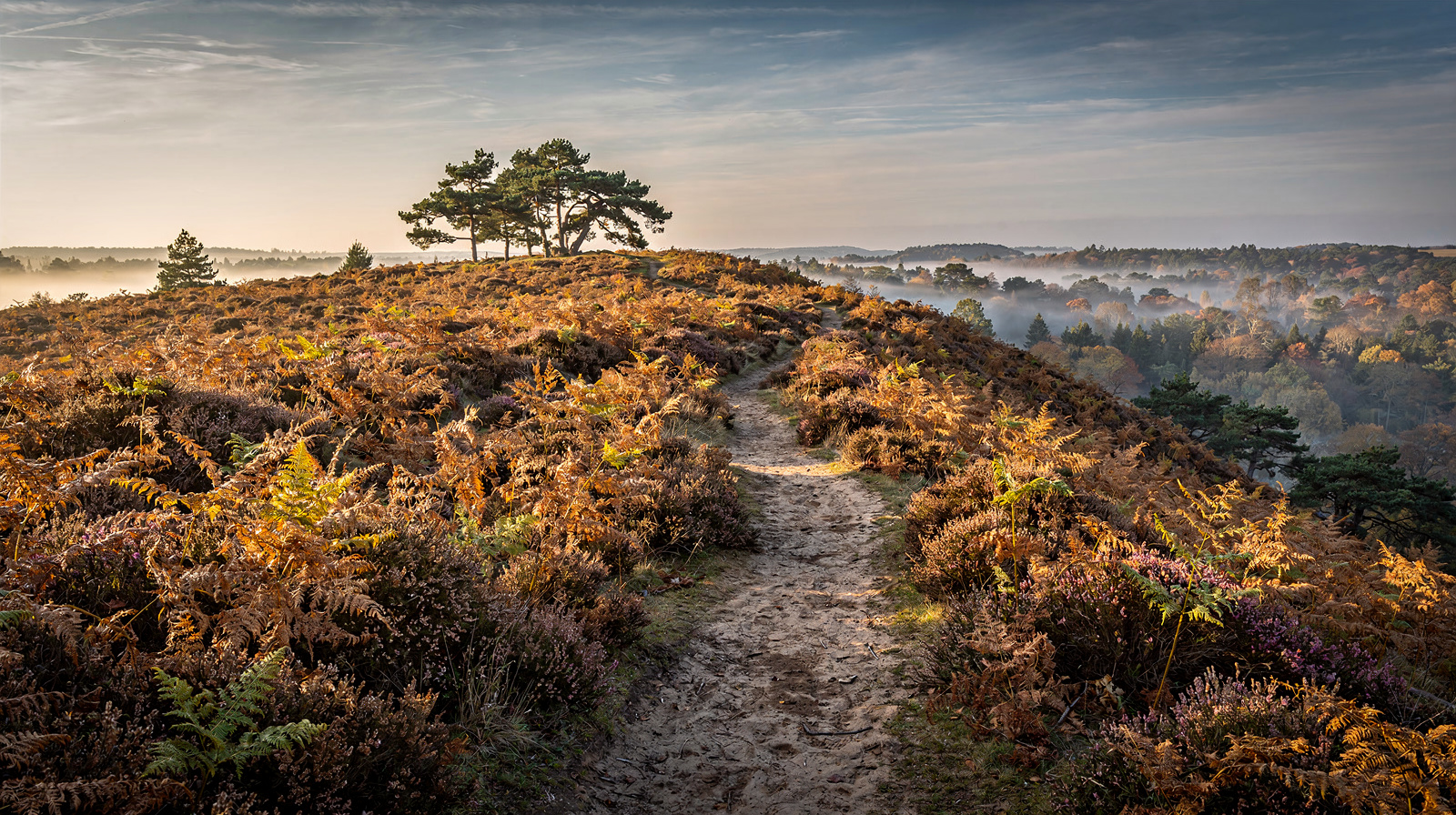
Ashdown Forest is 2,500 hectares, and nearly two thirds of it is open heath — 1,500 hectares of lowland heathland, the largest stretch of that habitat left in south-east England and a protected area for the nightjars that fly in from Africa to breed on it. Which is why October is the month. The colour here is not leaves but bracken, turning from green through bronze to rust across the month, with the last of the heather going over underneath. On a clear morning with mist in the Weald below, the ridges photograph like a Shepard plate.
Two things catch first-time visitors out. All 45 forest car parks are paid now, one shared code for the app, £2 for an hour and £5 for the day, cash only at the Forest Centre in office hours. And the paths off the main rides are wet clay that stays wet: boots, not trainers, and a change of shoes in the car.
Steam, acers and a vineyard between them
Ten miles south the High Weald does autumn the conventional way. Sheffield Park, the National Trust’s Capability Brown lake garden, holds 240 acers across 25 species and peaks in the second half of October; the Trust runs a live colour-watch blog and warns that the car park closes when full at weekends, so go on a weekday and before eleven. The garden gates open onto the Bluebell Railway, eleven miles of preserved steam line to East Grinstead, and 16–18 October is its Giants of Steam weekend, with the Duke of Gloucester visiting alongside the home fleet; a day rover is £38.50 and children pay a pound at weekends on ordinary running days. Bluebell Vineyard Estates sits literally between the two, pouring English sparkling wine on self-guided walks through the vines; Kingscote, nearer East Grinstead, does the tour-and-lunch version under the railway embankment.
Eat on the forest edge. The Hatch Inn at Coleman’s Hatch is three cottages from 1430 that became an inn in the eighteenth century, with two gardens facing the heath and a daily menu that gets it into the Good Pub Guide every year; the local legend that it was a smugglers’ rum house run by Captain Kidd is how the road up to Gills Lap came to be called Kidd’s Hill. The Gallipot in Upper Hartfield is the sixteenth-century one nearest the bridge walk. And Ashdown Park’s Hunny Pot afternoon tea, £38 for adults and £16 for children until the end of November, is the centenary’s one edible event: honey and orange cake, honeycomb choux, a cheese-and-ham bake called The Woozle.
Two walks on film, one by a fan and one by a guide:
I Visited Winnie the Pooh's Real Life Hundred Acre Wood in the English Countryside
Elle McLemore
The Real 100 Acre Wood – Home of Winnie-the-Pooh. Ashdown Forest.
Let's Go Walking Tours
Hartfield, Forest Row or the manor by Gatwick
Ashdown Park is the centenary hotel: a nineteenth-century mansion in 186 acres on the forest edge, with its own free Hundred Aker Trail through the grounds (1.8 km red route, 4.1 km blue, open to non-residents) and, on Saturday 17 October, an evening with Gyles Brandreth — four courses, Champagne, a book signing and a viewing of an original 1920s Farnell Alpha bear, the make Christopher Robin owned, at £195 a head with rooms from £225. Gravetye Manor, twenty minutes north, is the serious alternative: seventeen rooms in an Elizabethan house, a Michelin star, William Robinson’s original wild garden and Gatwick ten minutes away, which makes it the obvious first night off a Dutch flight. The Beacon above Tunbridge Wells has seven rooms and puts you nearer the vineyards. For a week with children, Pooh Corner keeps a list of cottages within walking distance of the bridge. Cotchford Farm, Milne’s own house, is private, but it now lets by the night as a six-bedroom holiday home with his study as the sitting room; for one family this October that is the trip.
From London Victoria
Southern trains reach East Grinstead in 57 minutes, about 37 a day, and the Metrobus 291 carries on to Hartfield in three quarters of an hour — but the bus does not go near Gills Lap or the Pooh car park, and the landmarks are spread across those 45 car parks. Hire a car at Gatwick, half an hour away, or base in Hartfield and walk everything from the village. Pooh Trek runs private guided days collecting from the station for anyone who would rather not drive on the left. October averages 15°C, fourteen wet days and four hours of sun; the forest is better for it.
Four weeks until the book turns a hundred. The six new trails, the bridge walk, the Giants of Steam weekend, Sheffield Park’s colour watch, the two forest pubs and the manor rooms are all in our Ashdown Forest collection — save it, pick a damp Tuesday in October, and drop your stick on the upstream side.
This guide was curated using Epic Itineraries — save links from anywhere on the web, organise them into collections, and turn research into itineraries.